Free Washington DMV CDL — General Knowledge Practice Test 2026
The Washington CDL — General Knowledge knowledge test has ~50 questions, and you need ~40 correct (80%) to pass. Practice free with questions written from the official Washington driver handbook — every one has a clear explanation, and you can retake as often as you like with no sign-up.
Content reviewed against official driver handbooks · August 12, 2026
What's on the Washington written test
The Washington CDL — General Knowledge knowledge test has ~50 questions; you need ~40 correct (80%) to pass.
Based on the official Washington exam format — always confirm current details with your state DMV.
Practice by topic
Focus on one area at a time — each topic has its own set of Washington practice questions.
Learn the shapes, colors, and meanings of regulatory, warning, and guide signs — from stop and yield to construction and school-zone signs.
Speed limits, turning and signaling rules, headlight and seat-belt requirements, and the everyday laws every driver must follow.
How to read traffic signals, lane lines, and pavement markings — including yellow and white lines, arrows, and flashing lights.
Who goes first at intersections, four-way stops, roundabouts, and crosswalks, and how to yield to pedestrians and emergency vehicles.
Following distance, scanning, blind spots, using your lights, and the habits that prevent crashes and keep you in control.
Driving safely around motorcycles, bicycles, large trucks, pedestrians, and school buses — and knowing who has the right of way.
Blood alcohol limits, zero-tolerance and implied-consent laws, and how alcohol and drugs — legal or not — affect your driving.
Legal and illegal parking, colored curbs, distances from hydrants and crossings, and how to park safely on hills.
Choosing a safe speed, keeping a space cushion, adjusting for weather and traffic, and understanding stopping distance.
What to do when things go wrong — brake failure, tire blowouts, skids, and stalling on railroad tracks.
The point system, license suspension, provisional-license rules, insurance requirements, and other licensing basics.
How to pass the first time
- Read the official Washington driver handbook at least once before test day.
- Practice by topic to find your weak spots, then fix them.
- Take full-length practice tests until you pass comfortably every time.
- Read every explanation — understanding beats memorizing.
Washington CDL — General Knowledge test — frequently asked questions
How many questions are on the Washington CDL — General Knowledge test?
The Washington CDL — General Knowledge knowledge test has ~50 questions, and you need ~40 correct (80%) to pass. Our practice tests mirror that format.
How many questions can I miss on the Washington CDL — General Knowledge test?
You can miss up to ~10 of the ~50 questions and still pass — you need ~40 correct, which is 80%.
Can I retake the practice test?
Yes — practice as often as you like, completely free. The questions and answer choices are shuffled each time.
Can I take the Washington practice test in Spanish?
Yes. Every question here is available in English and Spanish — switch languages anytime. Many states also offer the real knowledge test in languages other than English; confirm what Washington offers with your DMV.
Can I practice on my phone?
Yes. The practice tests work in any mobile or desktop browser — no app or sign-up needed — so you can study anywhere.
Are these the real DMV test questions?
No. Our questions are original, written from the current official Washington driver handbook to match the real test's topics and style. We are not affiliated with any DMV or government agency.
What's the best way to study?
Read the Washington driver handbook, practice by topic to target weak areas, and finish with full-length tests until you consistently pass.
Other Washington practice tests
Take the CDL — General Knowledge test in another state
Every Washington question is written from the official Washington driver handbook and checked against its current edition. DMV Test Free is a free, independent study resource — not affiliated with any DMV or government agency. About DMV Test Free
Washington CDL — General Knowledge questions with answers
20 sample questions from the Washington CDL — General Knowledge question bank — each with the correct answer, a short explanation, and the section of the official handbook it comes from.
Show all 20 questions with answers
1. If your vehicle does not have self-canceling turn signals, when should you turn the signal off?
Correct answer: After you have finished the turn
You should keep the signal on continuously through the maneuver and cancel it only after the turn is complete.
Source: Washington CDL Guide — Section 2: Driving Safely (Signal Your Intentions)
2. Which abilities does alcohol impair that are needed for safe driving?
Correct answer: Coordination, reaction time, depth perception, and judgment
Alcohol impairs muscle coordination, reaction time, depth perception, and night vision, and it affects judgment.
Source: Washington CDL Guide — Section 2: Driving Safely (Alcohol and Driving)
3. Regarding overhead clearance, how does an empty cargo van compare to a loaded one?
Correct answer: An empty van is higher than a loaded van
An empty van rides higher than a loaded one, so clearing a bridge loaded does not guarantee you will clear it empty.
Source: Washington CDL Guide — Section 2: Driving Safely (Space Overhead)
4. Which set of warning devices satisfies the emergency-equipment requirement for a commercial vehicle?
Correct answer: Three reflective triangles, or six fusees, or three flares
Acceptable warning devices are three reflective triangles, or at least six fusees, or three liquid-burning flares.
Source: Washington CDL Guide — Section 2: Driving Safely (Emergency Equipment)
5. How do you correct a drive-wheel braking skid, where the rear wheels have locked and are sliding?
Correct answer: Stop braking and then counter-steer
Stop braking so the rear wheels can roll again, then counter-steer as the vehicle comes back on course.
Source: Washington CDL Guide — Section 2: Driving Safely (Correcting a Drive-wheel Braking Skid)
6. A diamond-shaped placard reading 'Flammable' with the number 3 would be required for which of the following cargoes?
Correct answer: A tank of gasoline
Hazard Class 3 covers flammable liquids such as gasoline; the numbered diamond placard identifies that hazard class to others.
Source: Washington CDL Guide — Section 2: Driving Safely (Hazard Class Definitions)
7. On a wet road, by about how much should you reduce your speed compared with a dry road?
Correct answer: By about one-third
On a wet road, reduce your speed by about one-third, for example from 55 to around 35 mph.
Source: Washington CDL Guide — Section 2: Driving Safely (Matching Speed to the Road Surface)
8. Unless a lower limit is posted, what is the top speed for trucks and buses on interstate and Washington state highways?
Correct answer: 60 mph
The maximum speed for trucks and buses on interstate and state highways is 60 mph unless signs post something lower.
Source: Washington CDL Guide — Section 1: Introduction (Speed limits)
9. What happens if you are required to keep a certified medical status and fail to keep your medical examiner's certificate up to date?
Correct answer: You become not-certified and may lose your CDL
If you fail to keep your medical examiner's certificate current, you become 'not-certified' and may lose your CDL.
Source: Washington CDL Guide — Section 1: Introduction (Medical Documentation Requirements)
10. You are approaching a long, steep downhill grade. When should you shift into a low gear?
Correct answer: Before you start down the grade
Slow down and shift to a low gear before starting down the hill; you may not be able to downshift once speed builds up.
Source: Washington CDL Guide — Section 2: Driving Safely (Basic Procedures for Shifting Down)
11. You approach an emergency vehicle stopped with its lights on at the roadside. Under the move-over law, what should you do first if it is safe?
Correct answer: Move into a lane not next to the emergency vehicle
Where safe, you should slow down and change into a lane that is not next to the stopped emergency vehicle or work zone.
Source: Washington CDL Guide — Section 2: Driving Safely (Hazardous Roads)
12. You are about to pass a slower vehicle at night. How can you let that driver know you are there?
Correct answer: Flash your lights from low to high beam and back
At night you can signal your presence when passing by flashing your lights from low to high beam and back, assuming the other driver does not see you.
Source: Washington CDL Guide — Section 2: Driving Safely (Communicating Your Presence)
13. Which of these servings contains about the same amount of alcohol as a 12-ounce glass of beer?
Correct answer: A 1.5-ounce shot of 80-proof liquor
A 12-ounce beer, a 5-ounce glass of table wine, and a 1.5-ounce shot of 80-proof liquor all contain the same amount of alcohol.
Source: Washington CDL Guide — Section 2: Driving Safely (What Is a Drink?)
14. When you are about to pass a pedestrian or bicyclist, what should you assume?
Correct answer: Assume they do not see you and could move into your path
Whenever you pass a pedestrian, bicyclist, or another vehicle, assume they do not see you and could move into your path.
Source: Washington CDL Guide — Section 2: Driving Safely (When Passing)
15. After stopping on a road or its shoulder, how quickly must you set out your emergency warning devices?
Correct answer: Within 10 minutes
Set out your warning devices no more than 10 minutes after you stop on a road or shoulder.
Source: Washington CDL Guide — Section 2: Driving Safely (Communicating Your Presence)
16. What are the three basic steps to take at any accident scene when you are not seriously hurt?
Correct answer: Protect the area, notify authorities, and care for the injured
The basic steps at any accident are to protect the area, notify authorities, and care for the injured.
Source: Washington CDL Guide — Section 2: Driving Safely (Accident Procedures)
17. On a long mountain downgrade you pass signs pointing out an escape ramp. What is that ramp for?
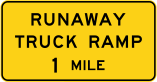
Correct answer: A ramp of soft material to stop a runaway vehicle safely
Escape ramps use a long bed of loose material, often on an upgrade, to safely stop a runaway vehicle that has lost braking power.
Source: Washington CDL Guide — Section 2: Driving Safely (Mountain Driving)
18. Why is it important to slow down before entering a curve rather than braking in it?
Correct answer: Braking in a curve makes it easy to lock the wheels and skid
Braking in a curve is dangerous because it is easier to lock the wheels and cause a skid, so slow to a safe speed before the curve.
Source: Washington CDL Guide — Section 2: Driving Safely (Speed and Curves)
19. For property-carrying drivers, driving is not allowed beyond which hour after first coming on duty following 10 hours off?
Correct answer: The 14th hour
You cannot drive past the 14th hour after coming on duty, even if you have not used all 11 driving hours.
Source: Washington CDL Guide — Section 1: Introduction (Hours of service)
20. What is the disqualification for a second conviction of texting or using a hand-held phone while operating a CMV within three years?
Correct answer: A 60-day disqualification
A second conviction for texting or hand-held phone use while operating a CMV within three years results in a 60-day disqualification, and a third within three years is 120 days.
Source: Washington CDL Guide — Section 2: Driving Safely (Cell/Mobile Phones)