Free California DMV Car / Permit Practice Test 2026
The California Car / Permit knowledge test has 36 questions, and you need 30 correct (83%) to pass. Practice free with questions written from the official California driver handbook — every one has a clear explanation, and you can retake as often as you like with no sign-up.
Content reviewed against official driver handbooks · August 12, 2026
What's on the California written test
The California Car / Permit knowledge test has 36 questions; you need 30 correct (83%) to pass.
Based on the official California exam format — always confirm current details with your state DMV.
The 36-question figure is the adult (18+) Class C test; applicants under 18 take a longer 46-question version.
Prefer to study on paper?
We make and sell this edition ourselves — it is our own product, not a partner's, and nobody paid us to show it to you. Everything inside it is also free to read on this site; what you are buying is the printable format.

Study offline
California Practice Test Pack — 2026 Printable Edition
All 410 California practice questions with worked explanations and answer keys — car, motorcycle, CDL and air brakes, in English and Spanish. Eight print-ready PDFs, 597 pages; the car and CDL editions add 146 cut-out road-sign flashcards.
Get the printable edition — $4.99- One-time purchase
- Instant download
- 14-day refund
Practice by topic
Focus on one area at a time — each topic has its own set of California practice questions.
Learn the shapes, colors, and meanings of regulatory, warning, and guide signs — from stop and yield to construction and school-zone signs.
Speed limits, turning and signaling rules, headlight and seat-belt requirements, and the everyday laws every driver must follow.
How to read traffic signals, lane lines, and pavement markings — including yellow and white lines, arrows, and flashing lights.
Who goes first at intersections, four-way stops, roundabouts, and crosswalks, and how to yield to pedestrians and emergency vehicles.
Following distance, scanning, blind spots, using your lights, and the habits that prevent crashes and keep you in control.
Driving safely around motorcycles, bicycles, large trucks, pedestrians, and school buses — and knowing who has the right of way.
Blood alcohol limits, zero-tolerance and implied-consent laws, and how alcohol and drugs — legal or not — affect your driving.
Legal and illegal parking, colored curbs, distances from hydrants and crossings, and how to park safely on hills.
Choosing a safe speed, keeping a space cushion, adjusting for weather and traffic, and understanding stopping distance.
What to do when things go wrong — brake failure, tire blowouts, skids, and stalling on railroad tracks.
The point system, license suspension, provisional-license rules, insurance requirements, and other licensing basics.
How to pass the first time
- Read the official California driver handbook at least once before test day.
- Practice by topic to find your weak spots, then fix them.
- Take full-length practice tests until you pass comfortably every time.
- Read every explanation — understanding beats memorizing.
California Car / Permit test — frequently asked questions
How many questions are on the California Car / Permit test?
The California Car / Permit knowledge test has 36 questions, and you need 30 correct (83%) to pass. Our practice tests mirror that format.
How many questions can I miss on the California Car / Permit test?
You can miss up to 6 of the 36 questions and still pass — you need 30 correct, which is 83%.
Can I retake the practice test?
Yes — practice as often as you like, completely free. The questions and answer choices are shuffled each time.
Can I take the California practice test in Spanish?
Yes. Every question here is available in English and Spanish — switch languages anytime. Many states also offer the real knowledge test in languages other than English; confirm what California offers with your DMV.
Can I practice on my phone?
Yes. The practice tests work in any mobile or desktop browser — no app or sign-up needed — so you can study anywhere.
Are these the real DMV test questions?
No. Our questions are original, written from the current official California driver handbook to match the real test's topics and style. We are not affiliated with any DMV or government agency.
What's the best way to study?
Read the California driver handbook, practice by topic to target weak areas, and finish with full-length tests until you consistently pass.
Other California practice tests
Take the Car / Permit test in another state
Every California question is written from the official California driver handbook and checked against its current edition. DMV Test Free is a free, independent study resource — not affiliated with any DMV or government agency. About DMV Test Free
California Car / Permit questions with answers
20 sample questions from the California Car / Permit question bank — each with the correct answer, a short explanation, and the section of the official handbook it comes from.
Show all 20 questions with answers
1. In California, a child must ride in a car seat or booster seat until they are:
Correct answer: At least 8 years old or 4 feet 9 inches tall
Children under 8 years old must ride in an appropriate car seat or booster in the back seat, unless they are at least 4 feet 9 inches tall. Children under 2 must ride in a rear-facing seat (with limited exceptions).
2. At a T-intersection without signs or signals, who has the right-of-way?
Correct answer: Traffic on the through road
At an uncontrolled T-intersection, traffic on the through road (the top of the 'T') has the right-of-way. A driver on the ending road must yield.
3. What does a yellow diamond-shaped sign showing a red-and-white yield symbol mean?

Correct answer: A yield sign is ahead; be prepared to yield.
A yield sign is ahead; be prepared to yield. (This is the "Yield Ahead" sign.)
4. If your brakes suddenly stop working, you should first:
Correct answer: Pump the pedal, downshift, and use the parking brake gradually
If your brakes fail, pump the brake pedal quickly to try to build pressure, shift to a lower gear, and use the parking brake gradually. Steer to a safe place off the road.
Source: California Driver Handbook — Handling Emergencies / Brake Failure
5. You may not park within how many feet of a fire hydrant?
Correct answer: 15 feet
You may not park within 15 feet of a fire hydrant so that fire crews can reach it in an emergency.
6. When following a large truck or bus that blocks your view, you should:
Correct answer: Increase your following distance so you can see ahead
Drop back and leave more space when behind a large vehicle. The extra distance lets you see farther ahead and gives the truck driver a chance to see you in the mirrors.
7. When approaching a light rail vehicle on the tracks, you should never:
Correct answer: Turn in front of an approaching light rail vehicle
Cutting across the path of an oncoming light rail vehicle is never safe, so look for one before crossing its tracks; be aware these vehicles can also change nearby traffic signals.
Source: California Driver Handbook — Light Rail Vehicles
8. While driving in California, you are required to carry proof of:
Correct answer: Vehicle insurance (financial responsibility)
California's financial-responsibility law requires you to carry evidence of insurance and show it when asked. Driving without insurance can lead to fines and a suspended registration.
Source: California Driver Handbook — Financial Responsibility
9. A solid yellow line on your side of the center of a two-way road means:
Correct answer: Passing is not allowed on your side
A solid yellow line on your side means passing is not allowed. You may cross it only to make a legal left turn.
10. California law requires you to turn on your headlights whenever you:
Correct answer: Use your windshield wipers because of weather
If weather conditions require you to use your windshield wipers — rain, snow, mist, or fog — you must also turn on your headlights (low beams).
11. In California, it is illegal to have an open container of alcohol:
Correct answer: In the passenger area of the vehicle
It is illegal to have an open container of alcohol in the passenger area of your vehicle, even if you are not drinking it. Store it in the trunk or an area not occupied by passengers.
12. Which of the following helps reduce the effects of sun glare while driving?
Correct answer: Wearing polarized sunglasses and keeping the windshield clean
Keeping your windshield clean, wearing polarized sunglasses, and avoiding driving directly toward sunrise or sunset all help manage sun glare.
Source: California Driver Handbook — Sun Glare
13. Two vehicles meet on a steep, narrow mountain road where neither can pass. Which vehicle has the right-of-way?
Correct answer: The vehicle facing uphill
Priority goes to the driver headed uphill, since the downhill driver typically finds it easier to reverse and clear space for the other car to get by.
Source: California Driver Handbook — Mountain Roads
14. You approach a white rectangular sign reading 'DO NOT PASS'. What does it tell you to do?
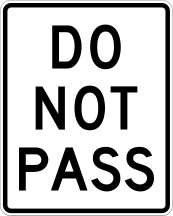
Correct answer: Passing other vehicles is prohibited beyond this sign.
Passing other vehicles is prohibited beyond this sign. (This is the "Do Not Pass" sign.)
15. When driving in high winds, you should avoid using cruise control because:
Correct answer: You need full control of the accelerator to react to gusts
Cruise control reduces your control over the accelerator, and you need to be able to react quickly to sudden wind gusts, so it is safer to control your speed manually.
Source: California Driver Handbook — High Winds
16. Under California's "daylighting" law, you generally may not stop or park within 20 feet of:
Correct answer: The approach side of a crosswalk
To make pedestrians easier to see, you may not park within 20 feet of the approach (vehicle) side of any marked or unmarked crosswalk — even where the curb is not painted red. The distance is 15 feet where a curb extension is present.
Source: California Driver Handbook — Parking / Daylighting Law
17. You should increase your following distance when:
Correct answer: The road is wet or your view is blocked
Increase your following distance in rain, fog, or ice, when being tailgated, when following a motorcycle, or when behind a large vehicle that blocks your view.
18. A large truck or bus is making a right turn in front of you and swings wide to the left first. You should:
Correct answer: Stay back and never squeeze to the right of the truck
Trucks and buses often swing wide (even into the left lane) to complete a right turn. Never try to squeeze between the vehicle and the curb — you could be crushed. Wait until the turn is complete.
Source: California Driver Handbook — Sharing the Road with Trucks
19. Your driving privilege may be suspended as a "negligent operator" if you receive:
Correct answer: 4 points in 12 months
You may be declared a negligent operator and have your license suspended if you accumulate 4 points in 12 months, 6 points in 24 months, or 8 points in 36 months.
20. A flashing yellow traffic signal light (not an arrow) means:
Correct answer: Proceed with caution; you do not need to stop
This flashing signal is telling you to slow down and stay alert as you continue through; unlike a flashing red light, a full stop is not required.
Source: California Driver Handbook — Traffic Signal Lights