Free California DMV CDL — General Knowledge Practice Test 2026
The California CDL — General Knowledge knowledge test has ~50 questions, and you need ~40 correct (80%) to pass. Practice free with questions written from the official California driver handbook — every one has a clear explanation, and you can retake as often as you like with no sign-up.
Content reviewed against official driver handbooks · August 12, 2026
What's on the California written test
The California CDL — General Knowledge knowledge test has ~50 questions; you need ~40 correct (80%) to pass.
Based on the official California exam format — always confirm current details with your state DMV.
Prefer to study on paper?
We make and sell this edition ourselves — it is our own product, not a partner's, and nobody paid us to show it to you. Everything inside it is also free to read on this site; what you are buying is the printable format.

Study offline
California Practice Test Pack — 2026 Printable Edition
All 410 California practice questions with worked explanations and answer keys — car, motorcycle, CDL and air brakes, in English and Spanish. Eight print-ready PDFs, 597 pages; the car and CDL editions add 146 cut-out road-sign flashcards.
Get the printable edition — $4.99- One-time purchase
- Instant download
- 14-day refund
Practice by topic
Focus on one area at a time — each topic has its own set of California practice questions.
Learn the shapes, colors, and meanings of regulatory, warning, and guide signs — from stop and yield to construction and school-zone signs.
Speed limits, turning and signaling rules, headlight and seat-belt requirements, and the everyday laws every driver must follow.
How to read traffic signals, lane lines, and pavement markings — including yellow and white lines, arrows, and flashing lights.
Who goes first at intersections, four-way stops, roundabouts, and crosswalks, and how to yield to pedestrians and emergency vehicles.
Following distance, scanning, blind spots, using your lights, and the habits that prevent crashes and keep you in control.
Driving safely around motorcycles, bicycles, large trucks, pedestrians, and school buses — and knowing who has the right of way.
Blood alcohol limits, zero-tolerance and implied-consent laws, and how alcohol and drugs — legal or not — affect your driving.
Legal and illegal parking, colored curbs, distances from hydrants and crossings, and how to park safely on hills.
Choosing a safe speed, keeping a space cushion, adjusting for weather and traffic, and understanding stopping distance.
What to do when things go wrong — brake failure, tire blowouts, skids, and stalling on railroad tracks.
The point system, license suspension, provisional-license rules, insurance requirements, and other licensing basics.
How to pass the first time
- Read the official California driver handbook at least once before test day.
- Practice by topic to find your weak spots, then fix them.
- Take full-length practice tests until you pass comfortably every time.
- Read every explanation — understanding beats memorizing.
California CDL — General Knowledge test — frequently asked questions
How many questions are on the California CDL — General Knowledge test?
The California CDL — General Knowledge knowledge test has ~50 questions, and you need ~40 correct (80%) to pass. Our practice tests mirror that format.
How many questions can I miss on the California CDL — General Knowledge test?
You can miss up to ~10 of the ~50 questions and still pass — you need ~40 correct, which is 80%.
Can I retake the practice test?
Yes — practice as often as you like, completely free. The questions and answer choices are shuffled each time.
Can I take the California practice test in Spanish?
Yes. Every question here is available in English and Spanish — switch languages anytime. Many states also offer the real knowledge test in languages other than English; confirm what California offers with your DMV.
Can I practice on my phone?
Yes. The practice tests work in any mobile or desktop browser — no app or sign-up needed — so you can study anywhere.
Are these the real DMV test questions?
No. Our questions are original, written from the current official California driver handbook to match the real test's topics and style. We are not affiliated with any DMV or government agency.
What's the best way to study?
Read the California driver handbook, practice by topic to target weak areas, and finish with full-length tests until you consistently pass.
Other California practice tests
Take the CDL — General Knowledge test in another state
Every California question is written from the official California driver handbook and checked against its current edition. DMV Test Free is a free, independent study resource — not affiliated with any DMV or government agency. About DMV Test Free
California CDL — General Knowledge questions with answers
20 sample questions from the California CDL — General Knowledge question bank — each with the correct answer, a short explanation, and the section of the official handbook it comes from.
Show all 20 questions with answers
1. Why is a high center of gravity (cargo loaded high or unevenly) dangerous?
Correct answer: It makes the vehicle more likely to roll over
A high center of gravity makes the vehicle more likely to tip over, especially in curves or during quick moves. Load heavier freight low and spread it out to keep the center of gravity low.
Source: California CDL Manual — Section 3: Transporting Cargo Safely
2. In many emergencies, which is quicker as a way to avoid a crash?
Correct answer: Steering around the hazard can be quicker than stopping
Stopping is not always the best move; you can often turn (steer) to miss an obstacle faster than you can stop for it. Keep a firm grip and make a smooth, quick steering move, then countersteer.
Source: California CDL Manual — Section 2: Driving Safely (Driving Emergencies)
3. At a gated railroad crossing, when may you finally drive across?
Correct answer: Once the gates have lifted and the red lights have stopped flashing
Stop as the lights start flashing and before the arm comes down, then wait it out. The gates rising and the lights going dark together are your sign that the crossing has been released.
Source: California Commercial Driver Handbook — Driving Safely (Railroad-Highway Crossings)
4. When should you select a safe speed and a low gear for a long, steep downgrade?
Correct answer: Before you start down the grade
Choose your safe speed and shift into a low gear before you start down the grade. Once you are already descending, it may be too late to shift down safely.
Source: California CDL Manual — Section 2: Driving Safely (Controlling Your Speed)
5. What blood alcohol concentration (BAC) makes it illegal to operate a commercial vehicle?
Correct answer: 0.04 or higher
It is illegal to drive a commercial vehicle with a BAC of 0.04 or higher, which is stricter than the 0.08 limit for regular drivers. Even smaller amounts of alcohol impair driving skills.
Source: California CDL Manual — Section 2: Driving Safely (Alcohol, Other Drugs, and Driving)
6. A small sign mounted underneath a crossbuck displays the numeral 2. What is it telling a commercial driver?
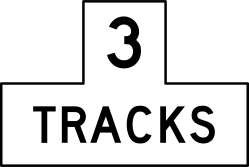
Correct answer: The roadway crosses two separate sets of rails here
Where a crossing spans more than one set of rails, a plate beneath the crossbuck gives the count. Knowing there are two tracks matters, because one train can easily screen another.
Source: California Commercial Driver Handbook — Driving Safely (Railroad-Highway Crossings)
7. Under the federal hours-of-service rules, how many hours may a property-carrying driver drive after 10 hours off duty?
Correct answer: 11 hours
After at least 10 consecutive hours off duty, a property-carrying driver may drive up to 11 hours. These limits are designed to reduce fatigue-related crashes.
Source: California Commercial Driver Handbook — Federal Requirements
8. When you are stopped on the side of the road or moving much slower than traffic, what should you turn on?
Correct answer: Your four-way emergency flashers
Turn on your four-way emergency flashers to warn other drivers. They tell approaching traffic that your vehicle is stopped or moving unusually slowly.
Source: California CDL Manual — Section 2: Driving Safely (Communicating)
9. Why should you never change gears while crossing railroad tracks?
Correct answer: You could miss a gear, stall, and get stuck on the tracks
Shifting on the tracks risks stalling or getting stuck if you miss the gear. Pick your gear before the crossing and keep moving steadily until you are all the way across.
Source: California CDL Manual — Section 2: Driving Safely (Railroad-Highway Crossings)
10. While you are walking out to set your reflective triangles, how should you carry them?
Correct answer: Held up between your body and the traffic coming toward you
The triangle is reflective, so holding it on the traffic side turns it into a high-visibility shield for you while you are exposed out on the roadway.
Source: California Commercial Driver Handbook — Driving Safely (Communicating)
11. Outside a business or residence district you want to overtake a vehicle crawling up a grade at less than 20 mph. What does the law require?
Correct answer: You must be able to pass at least 10 mph faster and finish within a quarter of a mile
Two conditions apply at once: your speed advantage has to be at least 10 mph, and the whole maneuver has to be finished inside a quarter of a mile. If you cannot satisfy both, stay behind.
Source: California Commercial Driver Handbook — Driving Safely (Controlling Your Speed)
12. When you have a choice, which direction should you back a large vehicle?
Correct answer: Toward the driver's (left) side, where you can see better
Back toward the driver's side whenever you can. You can see much better on that side by looking out the window, which reduces the chance of hitting something.
Source: California CDL Manual — Section 2: Driving Safely (Backing Safely)
13. If a fire breaks out in the cargo area of a sealed trailer, what should you NOT do?
Correct answer: Open the trailer doors to check on the fire
Do not open the trailer doors of a burning cargo box; letting in air can make the fire flare up. Keep the doors shut, park away from others, and wait for firefighters if you cannot safely fight it.
Source: California CDL Manual — Section 2: Driving Safely (Fires)
14. Students in the lower grades have to cross the road after leaving your school bus. What does California require of the driver?
Correct answer: Escort them across with an approved hand-held stop sign, walking them in front of the bus
For pupils from prekindergarten through eighth grade the driver leaves the seat and walks them over, carrying an approved hand-held stop sign, along a path in front of the bus where the driver can watch them the whole way.
Source: California Commercial Driver Handbook — School Buses (Loading and Unloading)
15. What is "perception distance" as part of total stopping distance?
Correct answer: The distance traveled from seeing a hazard until your brain recognizes it
Perception distance is how far your vehicle travels from the moment your eyes see a hazard until your brain recognizes it. It is separate from reaction distance, which is the distance traveled while you move your foot to the brake.
Source: California Commercial Driver Handbook — Driving Safely (Controlling Your Speed)
16. When may a commercial driver lawfully use a drug that a physician has prescribed for them?
Correct answer: When the physician has said it will not affect their ability to drive safely
A prescription on its own is not enough. The doctor has to state that the medication will not impair the driver's safe driving ability, and the driver still has to heed the warning labels on anything they take.
Source: California Commercial Driver Handbook — Driving Safely (Alcohol, Other Drugs, and Driving)
17. What does a yellow, diamond-shaped road sign mean?

Correct answer: It warns of a hazard or change in the road ahead
Yellow diamond-shaped signs are warning signs. They alert you to a hazard or a change in the road ahead, such as a curve, an intersection, or a crossing, so you can slow down and prepare.
Source: California CDL Manual — Section 2: Driving Safely (Traffic Signs and Signals)
18. If you are convicted of two serious traffic violations within three years, in separate incidents, how long is your CDL disqualified?
Correct answer: At least 60 days
Two serious traffic violations within three years lead to at least a 60-day disqualification; three within three years lead to at least 120 days. Serious violations include excessive speeding, reckless driving, and following too closely.
19. How do the convex (curved "spot") mirrors on a truck change what you see?
Correct answer: They make objects look smaller and farther away
Convex mirrors show a wider area but make objects look smaller and farther away than they really are. Remember this so you do not misjudge how close a vehicle actually is.
Source: California CDL Manual — Section 2: Driving Safely (Seeing to the Sides and Rear)
20. Which of these vehicles should make a commercial driver especially watchful for a sudden, unsafe move?
Correct answer: A rental truck, whose driver may not be used to its poor view to the rear and sides
Drivers who cannot see you rank among the most dangerous hazards on the road. Rental trucks, loaded vans, and cars with frost or snow across the glass all belong in that group.
Source: California Commercial Driver Handbook — Driving Safely (Seeing Hazards)