Free Florida DMV Car / Permit Practice Test 2026
The Florida Car / Permit knowledge test has 50 questions, and you need 40 correct (80%) to pass. Practice free with questions written from the official Florida driver handbook — every one has a clear explanation, and you can retake as often as you like with no sign-up.
Content reviewed against official driver handbooks · August 12, 2026
What's on the Florida written test
The Florida Car / Permit knowledge test has 50 questions; you need 40 correct (80%) to pass, within 60 minutes.
Based on the official Florida exam format — always confirm current details with your state DMV.
Prefer to study on paper?
We make and sell this edition ourselves — it is our own product, not a partner's, and nobody paid us to show it to you. Everything inside it is also free to read on this site; what you are buying is the printable format.
Study offline
Florida Practice Test Pack — 2026 Printable Edition
All 521 Florida practice questions with worked explanations and answer keys — car, motorcycle, CDL and air brakes, in English and Spanish. Eight print-ready PDFs, 780 pages; the car, motorcycle and CDL editions add 146 cut-out road-sign flashcards.
Get the printable edition — $4.99- One-time purchase
- Instant download
- 14-day refund
Practice by topic
Focus on one area at a time — each topic has its own set of Florida practice questions.
Learn the shapes, colors, and meanings of regulatory, warning, and guide signs — from stop and yield to construction and school-zone signs.
Speed limits, turning and signaling rules, headlight and seat-belt requirements, and the everyday laws every driver must follow.
How to read traffic signals, lane lines, and pavement markings — including yellow and white lines, arrows, and flashing lights.
Who goes first at intersections, four-way stops, roundabouts, and crosswalks, and how to yield to pedestrians and emergency vehicles.
Following distance, scanning, blind spots, using your lights, and the habits that prevent crashes and keep you in control.
Driving safely around motorcycles, bicycles, large trucks, pedestrians, and school buses — and knowing who has the right of way.
Blood alcohol limits, zero-tolerance and implied-consent laws, and how alcohol and drugs — legal or not — affect your driving.
Legal and illegal parking, colored curbs, distances from hydrants and crossings, and how to park safely on hills.
Choosing a safe speed, keeping a space cushion, adjusting for weather and traffic, and understanding stopping distance.
What to do when things go wrong — brake failure, tire blowouts, skids, and stalling on railroad tracks.
The point system, license suspension, provisional-license rules, insurance requirements, and other licensing basics.
How to pass the first time
- Read the official Florida driver handbook at least once before test day.
- Practice by topic to find your weak spots, then fix them.
- Take full-length practice tests until you pass comfortably every time.
- Read every explanation — understanding beats memorizing.
Florida Car / Permit test — frequently asked questions
How many questions are on the Florida Car / Permit test?
The Florida Car / Permit knowledge test has 50 questions, and you need 40 correct (80%) to pass. Our practice tests mirror that format.
How many questions can I miss on the Florida Car / Permit test?
You can miss up to 10 of the 50 questions and still pass — you need 40 correct, which is 80%.
How long do I have to take the Florida Car / Permit test?
The Florida Car / Permit knowledge test has a 60-minute time limit. Our timed exam simulation uses the same limit so you can practice your pacing.
Can I retake the practice test?
Yes — practice as often as you like, completely free. The questions and answer choices are shuffled each time.
Can I take the Florida practice test in Spanish?
Yes. Every question here is available in English and Spanish — switch languages anytime. Many states also offer the real knowledge test in languages other than English; confirm what Florida offers with your DMV.
Can I practice on my phone?
Yes. The practice tests work in any mobile or desktop browser — no app or sign-up needed — so you can study anywhere.
Are these the real DMV test questions?
No. Our questions are original, written from the current official Florida driver handbook to match the real test's topics and style. We are not affiliated with any DMV or government agency.
What's the best way to study?
Read the Florida driver handbook, practice by topic to target weak areas, and finish with full-length tests until you consistently pass.
Other Florida practice tests
Take the Car / Permit test in another state
Every Florida question is written from the official Florida driver handbook and checked against its current edition. DMV Test Free is a free, independent study resource — not affiliated with any DMV or government agency. About DMV Test Free
Florida Car / Permit questions with answers
20 sample questions from the Florida Car / Permit question bank — each with the correct answer, a short explanation, and the section of the official handbook it comes from.
Show all 20 questions with answers
1. What is the correct meaning of a white rectangular sign posting a weight limit in tons?
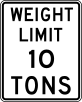
Correct answer: Vehicles over the posted weight may not use this road or bridge.
Vehicles over the posted weight may not use this road or bridge. (This is the "Weight Limit" sign.)
2. At night you should not 'overdrive' your headlights. This means you should:
Correct answer: Drive slowly enough to stop within the distance your headlights show
Overdriving your headlights means going so fast that you cannot stop within the lit distance ahead. Keep your speed low enough at night to stop safely inside the range your headlights show.
3. Driving much slower than the traffic around you on a highway is:
Correct answer: Dangerous and can be illegal, because it blocks the normal flow of traffic
Going too slowly can be as dangerous as speeding—it forces others to brake and pass. Unless conditions require a lower speed, keep pace with traffic without exceeding the limit, and let faster traffic pass.
4. What extra step does Florida require of drivers aged 80 and over when they renew a license?
Correct answer: Pass a vision exam
From the age of 80 onward, every renewal calls for a vision screening. It may be done at a service center, or by a Florida licensed eye doctor or physician who files the result with FLHSMV.
5. A two-way street has a middle lane edged with yellow lines and painted with left-turn arrows pointing both ways. That lane exists for:
Correct answer: Left turns by drivers heading in either direction
A shared center lane lets drivers coming from either end of the street wait there before turning left. Using it to get around slower traffic is against the law.
6. When you park facing downhill next to a curb, you should turn your front wheels:
Correct answer: Toward the curb
Facing downhill, turn the wheels toward the curb. If the car rolls, the curb blocks the front tire and keeps it from rolling into traffic.
7. When a school-zone reduced-speed period is in effect, you should not drive faster than:
Correct answer: 20 mph, or the posted school-zone speed
School-zone limits are low—commonly 20 mph or as posted—while the zone is active. Slow down and watch for children crossing or walking near the road.
8. At an open intersection with no signs or signals, you must yield to a vehicle that:
Correct answer: Reaches the intersection at about the same time from your right
When no signs or signals control an intersection, yield to vehicles already in it and to any vehicle reaching it at about the same time on your right.
9. Why might a motorcycle ahead of you lose speed without its brake light ever coming on?
Correct answer: Riders often slow by changing down a gear or easing the throttle
Riders often shed speed through the gearbox or by rolling the throttle back, and neither action lights the brake lamp. Watch the machine itself rather than waiting for the light, and hang well back.
Source: Florida Driver License Handbook — Sharing the Road with Motorcycles
10. If a front tire suddenly blows out at highway speed, you should first:
Correct answer: Grip the wheel firmly, ease off the gas, and let the car slow
In a blowout, hold the wheel firmly to keep the car straight, ease off the accelerator, and slow gradually before pulling off. Braking hard can cause a skid.
Source: Florida Driver License Handbook — Driving Emergencies
11. Which statement about drugs and driving in Florida is correct?
Correct answer: Prescription and over-the-counter medicines can impair driving and lead to a DUI
Driving under the influence covers any impairing substance—including legal prescription and over-the-counter medicines. Read labels for warnings and do not drive if a medication can affect your alertness or coordination.
Source: Florida Driver License Handbook — Alcohol and Other Drugs
12. What do orange traffic signs and cones tell you about the road ahead?
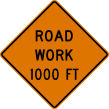
Correct answer: You are in or near a construction or work zone
Orange is the color for construction and maintenance zones. Slow down, watch for workers and equipment, and be ready for lane shifts or sudden stops.
Source: Florida Driver License Handbook — Construction and Maintenance Signs
13. What is the single most effective thing you can do to protect yourself in a crash?
Correct answer: Wear your safety belt correctly
Safety belts keep you in your seat and behind the wheel during a crash and are the best protection against injury and being thrown from the vehicle.
14. Which three lengths added together make up total stopping distance?
Correct answer: Perception distance, reaction distance and braking distance
First your eyes and brain register the hazard, then your foot travels to the pedal, and finally the brakes bring the car down to a halt. Those three lengths together are how far you cover before stopping.
15. Florida adds points to your driving record for traffic convictions. Accumulating too many points will:
Correct answer: Lead to suspension of your driving privilege
Convictions add points to your record. Too many points in a set period suspends your license—for example, 12 points within 12 months results in a 30-day suspension. More points mean longer suspensions.
16. Two solid white lines are painted between lanes that carry traffic the same way. What do they tell you?
Correct answer: Moving from one lane to the other across them is not permitted
A pair of unbroken white lines forbids lane changes altogether. Hold your position until the marking becomes a dashed white line, which is where moving over is permitted.
17. Before you leave your parked vehicle, you should:
Correct answer: Set the parking brake, shift to park (or into gear), and remove the key
Always set the parking brake, put an automatic in Park (or a manual in gear), turn off the engine, and take your key. This keeps the vehicle from rolling and from being taken.
18. In Florida, when is a left turn allowed at a steady red light?
Correct answer: From a one-way street onto another one-way street, after stopping and yielding
A left turn on red is permitted only when turning from a one-way street onto another one-way street, after a complete stop, unless a sign prohibits it.
19. At a two-way stop you are waiting to turn, while another driver at the same intersection intends to continue straight through. Who moves first?
Correct answer: The driver going straight, because a turning driver must yield
Florida gives the through movement priority at a two-way stop, so the driver who plans to turn waits for the vehicle carrying on straight ahead.
20. When passing a bicyclist on the road, Florida law says you must leave:
Correct answer: At least three feet of clearance
When passing a bicycle, you must give at least three feet of space. Bicyclists have the same rights and duties as drivers and can be hard to see.