Free New York DMV Car / Permit Practice Test 2026
The New York Car / Permit knowledge test has 20 questions, and you need 14 correct (70%) to pass. Practice free with questions written from the official New York driver handbook — every one has a clear explanation, and you can retake as often as you like with no sign-up.
Content reviewed against official driver handbooks · August 12, 2026
What's on the New York written test
The New York Car / Permit knowledge test has 20 questions; you need 14 correct (70%) to pass.
Based on the official New York exam format — always confirm current details with your state DMV.
Practice by topic
Focus on one area at a time — each topic has its own set of New York practice questions.
Learn the shapes, colors, and meanings of regulatory, warning, and guide signs — from stop and yield to construction and school-zone signs.
Speed limits, turning and signaling rules, headlight and seat-belt requirements, and the everyday laws every driver must follow.
How to read traffic signals, lane lines, and pavement markings — including yellow and white lines, arrows, and flashing lights.
Who goes first at intersections, four-way stops, roundabouts, and crosswalks, and how to yield to pedestrians and emergency vehicles.
Following distance, scanning, blind spots, using your lights, and the habits that prevent crashes and keep you in control.
Driving safely around motorcycles, bicycles, large trucks, pedestrians, and school buses — and knowing who has the right of way.
Blood alcohol limits, zero-tolerance and implied-consent laws, and how alcohol and drugs — legal or not — affect your driving.
Legal and illegal parking, colored curbs, distances from hydrants and crossings, and how to park safely on hills.
Choosing a safe speed, keeping a space cushion, adjusting for weather and traffic, and understanding stopping distance.
What to do when things go wrong — brake failure, tire blowouts, skids, and stalling on railroad tracks.
The point system, license suspension, provisional-license rules, insurance requirements, and other licensing basics.
How to pass the first time
- Read the official New York driver handbook at least once before test day.
- Practice by topic to find your weak spots, then fix them.
- Take full-length practice tests until you pass comfortably every time.
- Read every explanation — understanding beats memorizing.
New York Car / Permit test — frequently asked questions
How many questions are on the New York Car / Permit test?
The New York Car / Permit knowledge test has 20 questions, and you need 14 correct (70%) to pass. Our practice tests mirror that format.
How many questions can I miss on the New York Car / Permit test?
You can miss up to 6 of the 20 questions and still pass — you need 14 correct, which is 70%.
Can I retake the practice test?
Yes — practice as often as you like, completely free. The questions and answer choices are shuffled each time.
Can I take the New York practice test in Spanish?
Yes. Every question here is available in English and Spanish — switch languages anytime. Many states also offer the real knowledge test in languages other than English; confirm what New York offers with your DMV.
Can I practice on my phone?
Yes. The practice tests work in any mobile or desktop browser — no app or sign-up needed — so you can study anywhere.
Are these the real DMV test questions?
No. Our questions are original, written from the current official New York driver handbook to match the real test's topics and style. We are not affiliated with any DMV or government agency.
What's the best way to study?
Read the New York driver handbook, practice by topic to target weak areas, and finish with full-length tests until you consistently pass.
Other New York practice tests
Take the Car / Permit test in another state
Every New York question is written from the official New York driver handbook and checked against its current edition. DMV Test Free is a free, independent study resource — not affiliated with any DMV or government agency. About DMV Test Free
New York Car / Permit questions with answers
20 sample questions from the New York Car / Permit question bank — each with the correct answer, a short explanation, and the section of the official handbook it comes from.
Show all 20 questions with answers
1. While driving you see a white sign showing a right-turn arrow crossed out in red. What does it indicate?
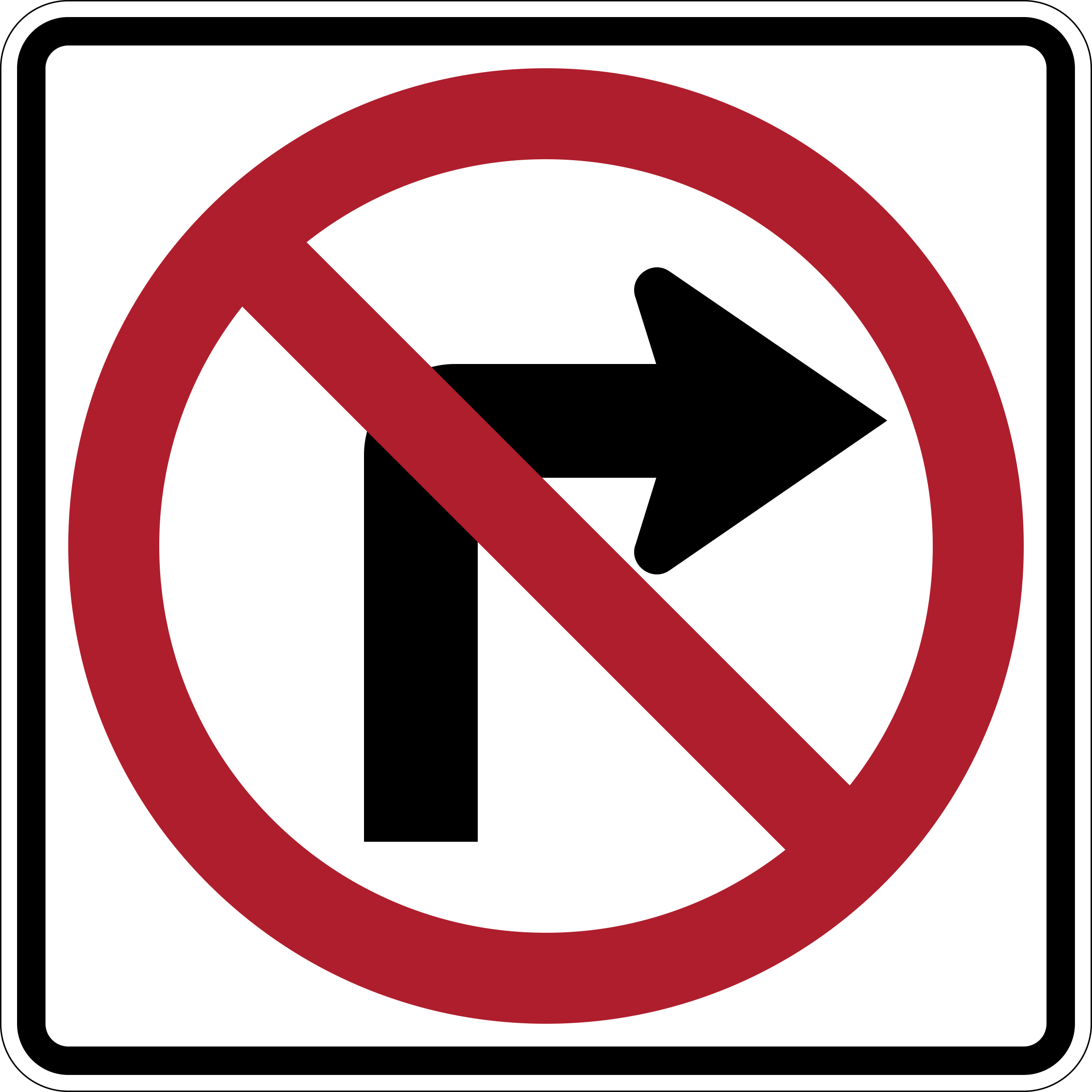
Correct answer: You may not turn right at this location.
You may not turn right at this location. (This is the "No Right Turn" sign.)
2. When may you leave your car in a space reserved for people with disabilities?
Correct answer: When you display the permit or special plates and the person it belongs to is riding with you
The space may be used only by a vehicle carrying the proper plates or permit, and only while it is transporting the person named on that document. Lying on the application is a misdemeanor and brings a mandatory revocation. Never stop in the striped area beside such a space either, since that aisle gives room for wheelchairs and lifts.
Source: New York State Driver's Manual — Parking, Stopping and Standing
3. Before you pull out of a driveway or parking lot onto a street, you must:
Correct answer: Yield to traffic and pedestrians already using the road and sidewalk
Vehicles already on the roadway and pedestrians on the sidewalk have the right-of-way. Stop, look both ways, and wait for a clear gap before entering the street.
4. Unless a different limit is posted, what is the speed limit on streets in New York City?
Correct answer: 25 mph
New York City's default speed limit is 25 mph unless signs post a different limit. The lower limit helps reduce the number and severity of crashes on busy city streets.
5. How much supervised practice must a junior applicant certify before taking the road test?
Correct answer: 50 hours, of which at least 15 come after sunset
A parent or guardian signs the Certification of Supervised Driving to confirm at least 50 hours behind the wheel with a qualified supervising driver, at least 15 of them after dark. Roughly 10 of those hours in moderate to heavy traffic is also recommended.
6. A broken (dashed) white line separates two lanes of traffic. What does it tell you?
Correct answer: You may change lanes when it is safe to do so
A dashed white line separates lanes moving in the same direction and means you may change lanes when it is safe. A solid white line means you should stay in your lane.
7. On a street with no bicycle lane, where does the law tell a bicyclist to ride?
Correct answer: Near the right curb, the road edge, or the right shoulder
Riders must keep near the right-hand curb, the road edge or the right shoulder so they do not hold up other traffic. They may move left to set up a left turn or to get around a hazard, and they always travel with the flow of traffic, never against it.
8. Under New York's open container rule, who can be ticketed?
Correct answer: The driver or any passenger who drinks or holds an opened container
Drinking, or simply holding an opened alcoholic container, is a traffic infraction for the driver and for passengers alike on a public road. The same rule covers using cannabis inside the vehicle. Stretch limousines and certain other permitted vehicles are exempt.
Source: New York State Driver's Manual — Alcohol and Other Drugs
9. What is the shallowest tire tread New York law allows?
Correct answer: 2/32 of an inch
Tread thinner than 2/32 of an inch is illegal. Most tires carry molded wear bars that show across the grooves at that depth, and the penny check works too: if the top of Lincoln's head stays visible in the deepest groove, the tire is finished. A tire is also illegal once it shows bulges, bumps, or cuts deep enough to expose the cords.
10. Modern roundabouts are engineered so that vehicles inside the circle travel no faster than what speed?
Correct answer: 30 mph
Tight diameters and curved entries hold circulating traffic to 30 mph or less, which is much of the reason these intersections are safer than ordinary ones. Anyone entering must wait for a gap and give way to traffic already going around.
11. A car is coming straight at you in your own lane. What should you do?
Correct answer: Slow down, steer toward the right, and sound your horn
Moving left is the trap: the other driver may snap awake and swerve back into that lane, putting you head-on once more. Shed speed, steer toward the right edge of the road, and use the horn to alert them.
Source: New York State Driver's Manual — Driving Emergencies
12. A white rectangular sign reading 'SPEED LIMIT' above a number is posted ahead. What does it mean?
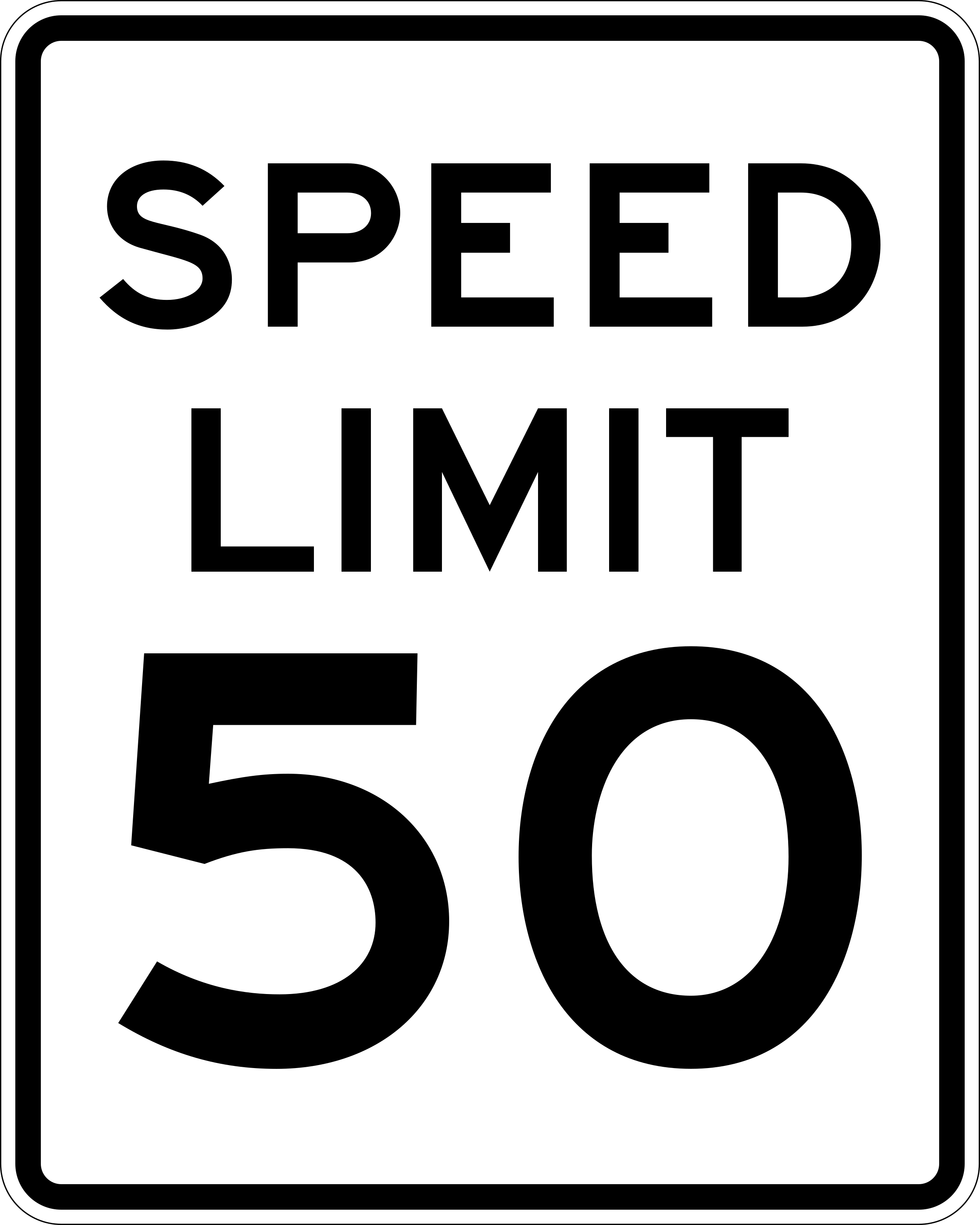
Correct answer: The maximum legal speed in ideal conditions; slow down for weather, traffic, or road conditions.
The maximum legal speed in ideal conditions; slow down for weather, traffic, or road conditions. (This is the "Speed Limit" sign.)
13. When you park facing downhill next to a curb, which way should you turn your front wheels?
Correct answer: Toward the curb
Facing downhill, turn your wheels toward the curb so the car rolls into the curb if the brakes slip. Facing uphill with a curb, turn them away from the curb. Always set the parking brake.
Source: New York State Driver's Manual — Parking, Stopping and Standing
14. Your light turns green, but a car that entered earlier is still finishing a left turn in front of you. What must you do?
Correct answer: Let that driver finish the turn before you enter
A green light does not settle every conflict at an intersection. Anyone already inside the crossing keeps the right-of-way, so hold back until that vehicle has cleared before you move in.
15. Under New York law, using a hand-held cell phone or texting while driving is:
Correct answer: Prohibited; adult drivers may use hands-free devices only
New York prohibits holding a phone to talk and prohibits texting while driving. Adult drivers may use hands-free equipment, but the safest choice is to put the phone away until you park.
16. Outside New York City, how many passengers under age 21 who are not immediate family may a junior (Class DJ) license holder carry?
Correct answer: No more than one
To limit distractions for new drivers, a junior license holder may carry only one passenger under 21 who is not an immediate family member. Junior-license rules are stricter in New York City and on Long Island.
Source: New York State Driver's Manual — Graduated License Law
17. A steady (not flashing) yellow traffic light means:
Correct answer: The light is about to turn red — stop if you can do so safely
A steady yellow light warns that the signal is about to turn red. Stop if you can do so safely; if you are already too close to stop, clear the intersection with care. Never speed up to beat the red.
18. How should you pass a bicyclist who is riding in your lane on a city street?
Correct answer: Slow down and pass leaving a safe distance, waiting if necessary
Bicyclists have the right to use the road and may need the full lane to avoid hazards like potholes or opening car doors. Slow down, wait for a safe gap, and pass leaving plenty of room.
19. A blood alcohol content of .18 percent or higher is evidence of which New York charge?
Correct answer: Aggravated driving while intoxicated
New York stacks a heavier charge above the ordinary intoxication threshold. Reaching .18 percent supports an aggravated DWI, which on a first conviction brings a revocation of at least one year along with a substantial fine.
Source: New York State Driver's Manual — Alcohol and Other Drugs
20. Where must a rear-facing child safety seat never be placed?
Correct answer: In a front seat where the passenger has an air bag
An air bag inflates with enough force to badly hurt or kill an infant riding backwards directly in front of it, so a rear-facing seat belongs in the back. Children must ride facing the rear until at least age two, or until they outgrow the height or weight limit the seat maker sets.