Free Georgia DMV CDL — General Knowledge Practice Test 2026
The Georgia CDL — General Knowledge knowledge test has ~50 questions, and you need ~40 correct (80%) to pass. Practice free with questions written from the official Georgia driver handbook — every one has a clear explanation, and you can retake as often as you like with no sign-up.
Content reviewed against official driver handbooks · August 12, 2026
What's on the Georgia written test
The Georgia CDL — General Knowledge knowledge test has ~50 questions; you need ~40 correct (80%) to pass.
Based on the official Georgia exam format — always confirm current details with your state DMV.
Practice by topic
Focus on one area at a time — each topic has its own set of Georgia practice questions.
Learn the shapes, colors, and meanings of regulatory, warning, and guide signs — from stop and yield to construction and school-zone signs.
Speed limits, turning and signaling rules, headlight and seat-belt requirements, and the everyday laws every driver must follow.
How to read traffic signals, lane lines, and pavement markings — including yellow and white lines, arrows, and flashing lights.
Following distance, scanning, blind spots, using your lights, and the habits that prevent crashes and keep you in control.
Driving safely around motorcycles, bicycles, large trucks, pedestrians, and school buses — and knowing who has the right of way.
Blood alcohol limits, zero-tolerance and implied-consent laws, and how alcohol and drugs — legal or not — affect your driving.
Legal and illegal parking, colored curbs, distances from hydrants and crossings, and how to park safely on hills.
Choosing a safe speed, keeping a space cushion, adjusting for weather and traffic, and understanding stopping distance.
What to do when things go wrong — brake failure, tire blowouts, skids, and stalling on railroad tracks.
The point system, license suspension, provisional-license rules, insurance requirements, and other licensing basics.
How to pass the first time
- Read the official Georgia driver handbook at least once before test day.
- Practice by topic to find your weak spots, then fix them.
- Take full-length practice tests until you pass comfortably every time.
- Read every explanation — understanding beats memorizing.
Georgia CDL — General Knowledge test — frequently asked questions
How many questions are on the Georgia CDL — General Knowledge test?
The Georgia CDL — General Knowledge knowledge test has ~50 questions, and you need ~40 correct (80%) to pass. Our practice tests mirror that format.
How many questions can I miss on the Georgia CDL — General Knowledge test?
You can miss up to ~10 of the ~50 questions and still pass — you need ~40 correct, which is 80%.
Can I retake the practice test?
Yes — practice as often as you like, completely free. The questions and answer choices are shuffled each time.
Can I take the Georgia practice test in Spanish?
Yes. Every question here is available in English and Spanish — switch languages anytime. Many states also offer the real knowledge test in languages other than English; confirm what Georgia offers with your DMV.
Can I practice on my phone?
Yes. The practice tests work in any mobile or desktop browser — no app or sign-up needed — so you can study anywhere.
Are these the real DMV test questions?
No. Our questions are original, written from the current official Georgia driver handbook to match the real test's topics and style. We are not affiliated with any DMV or government agency.
What's the best way to study?
Read the Georgia driver handbook, practice by topic to target weak areas, and finish with full-length tests until you consistently pass.
Other Georgia practice tests
Take the CDL — General Knowledge test in another state
Every Georgia question is written from the official Georgia driver handbook and checked against its current edition. DMV Test Free is a free, independent study resource — not affiliated with any DMV or government agency. About DMV Test Free
Georgia CDL — General Knowledge questions with answers
20 sample questions from the Georgia CDL — General Knowledge question bank — each with the correct answer, a short explanation, and the section of the official handbook it comes from.
Show all 20 questions with answers
1. When your vehicle has ABS and you must brake hard in an emergency, you should:
Correct answer: Apply firm, steady pressure and steer as needed
With ABS, brake normally by applying firm, steady pressure and steer as needed. Do not pump the pedal; the system rapidly prevents lockup for you.
2. You are approaching a city bus that has pulled over and stopped. The main danger is that:
Correct answer: Riders may walk into the road in front of or behind it
Riders getting off a stopped bus often step into the roadway ahead of it or behind it, and the bus body hides them from you just as it hides you from them.
3. 'Black ice' is especially dangerous because it:
Correct answer: Is a thin, clear layer that makes the road look only wet
Black ice is a thin, clear layer that makes the pavement look merely wet rather than frozen. Watch for it when it is below freezing and the road looks shiny; check your mirror arm or antenna for ice.
4. Federal rules require a commercial driver to be able to read and speak English well enough to:
Correct answer: Understand traffic signs, answer officials, and complete reports and records
A driver must understand highway signs and signals, talk with the public and respond to officials, and make entries on reports and records. This is a federal driver-qualification requirement.
5. A person who drives a commercial motor vehicle without holding a CDL can face:
Correct answer: A fine as high as $5,000, or a jail sentence
Operating a commercial vehicle with no CDL is a serious offense. A court has the power to impose a fine reaching $5,000, or to send the offender to jail.
6. A sign posting a low clearance height, such as 12 ft 6 in, tells a truck driver to:

Correct answer: Not enter if the vehicle is taller than the height shown
A low-clearance sign warns of the height of a bridge or overpass. If your loaded vehicle is taller than the posted height, do not enter; find another route to avoid striking the structure.
7. Using your brakes too much on a long downgrade can lead to:
Correct answer: Brake fade, where overheated brakes lose stopping power
Overusing the brakes makes them overheat, and overheated brakes fade, meaning they lose stopping power. Using engine braking and proper technique keeps the brakes cooler.
Source: Georgia CDL Manual — Brake Fade
8. You have just come down a long grade and your brakes are extremely hot. To hold the vehicle while you park, you should:
Correct answer: Chock the wheels on level ground and let the brakes cool
Applying parking brakes to very hot brakes can damage them with the retained heat, and applying them to soaked brakes in freezing weather can freeze the vehicle in place. Park on level ground, chock the wheels, and give the brakes time to cool first.
9. A driver commits a first alcohol-related offense while operating a commercial vehicle that is placarded for hazardous materials. The CDL will be lost for at least:
Correct answer: 3 years
The usual penalty for a first alcohol offense is a one-year loss of the CDL, but hauling placarded hazardous materials at the time raises that minimum to three years.
Source: Georgia CDL Manual — Alcohol, Leaving the Scene of an Accident, and Commission of a Felony
10. When you plan to turn, you should signal:
Correct answer: Early and continuously, so others know your intentions well ahead
Signal early and keep the signal on through the turn, so other drivers have plenty of warning of what you intend to do. A large vehicle needs even more warning because it moves slowly.
11. While you are driving through an intersection, a pedestrian is crossing in front of you. You should:
Correct answer: Slow down and yield to the pedestrian
When you drive through an intersection, keep checking traffic in all directions, slow down, and yield to pedestrians and other traffic already in the intersection.
12. If a tire suddenly blows out while you are driving, you should:
Correct answer: Hold the wheel firmly, stay off the brake, and let the vehicle slow
Braking right after a blowout can cause loss of control. Hold the steering wheel firmly, stay off the brake, and let the vehicle slow down. Brake gently only after it slows, then pull off the road.
13. You notice the driver of a car beside you eating and looking down at a phone. Your best response is to:
Correct answer: Give that driver plenty of room and pass with extra care
Around a driver whose attention is elsewhere, open up space and hold your following distance. Take extra care if you pass, since that driver may never register your vehicle and could drift into your path.
Source: Georgia CDL Manual — Watch Out for Other Distracted Drivers
14. Which emergency equipment must a commercial vehicle carry?
Correct answer: A rated fire extinguisher, spare fuses unless it has circuit breakers, and warning triangles
You must have a charged, properly rated fire extinguisher, spare electrical fuses (unless the vehicle uses circuit breakers), and warning devices such as three reflective triangles. Check that they are present before every trip.
15. For Entry-Level Driver Training to count toward a first Class A CDL, it must:
Correct answer: Come from a provider on the FMCSA Training Provider Registry and cover theory and behind-the-wheel training
The training must be given by a provider listed on the FMCSA Training Provider Registry, and it must include both classroom (theory) instruction and behind-the-wheel training. Only a registered provider can certify that you finished.
16. Under Georgia's 'Move Over' law, when you approach a stopped emergency or utility vehicle displaying flashing lights, you must:
Correct answer: Move over a lane if you safely can, or slow down if you cannot
Move over one lane away from the stopped vehicle if you can do so safely. If you cannot move over, you must slow down below the speed limit and be ready to stop.
17. On steep mountain downgrades you will see signs marking the location of escape ramps. These ramps exist to:
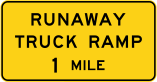
Correct answer: Bring a vehicle whose brakes have given out to a safe halt
An escape ramp uses a long bed of soft, loose material, often paired with an upgrade, to bring a runaway truck to a halt without hurting the driver or passengers. Learn where the ramps are before you drive a grade.
18. What is the safest way to handle a curve in a large vehicle?
Correct answer: Slow down before the curve, then accelerate gently through it
Slow to a safe speed before you enter the curve, then hold that speed or accelerate gently through it. Braking hard in a curve can cause a skid or rollover.
19. A placarded vehicle is parked on a public roadway. The person attending it must:
Correct answer: Stay awake in the vehicle, or within 100 feet of it with a clear view
The attendant has to stay in the vehicle and awake, out of the sleeper berth, or else remain no more than 100 feet away with the vehicle in plain sight. That person also has to understand the cargo's hazards, know the emergency steps, and be able to move the vehicle.
20. Which set of drinks all deliver about the same quantity of alcohol?
Correct answer: A 12-ounce beer at 5 percent, a 5-ounce glass of 12 percent wine, and a 1.5-ounce shot of 80 proof liquor
A twelve-ounce beer at five percent, a five-ounce pour of twelve percent wine, and a shot of an ounce and a half of eighty proof liquor each carry a comparable amount of alcohol, so none of them is the 'safe' choice.