Free North Carolina DMV Motorcycle Practice Test 2026
The North Carolina Motorcycle knowledge test has ~25 questions, and you need ~20 correct (~80%) to pass. Practice free with questions written from the official North Carolina driver handbook — every one has a clear explanation, and you can retake as often as you like with no sign-up.
Content reviewed against official driver handbooks · August 12, 2026
What's on the North Carolina written test
The North Carolina Motorcycle knowledge test has ~25 questions; you need ~20 correct (~80%) to pass.
Based on the official North Carolina exam format — always confirm current details with your state DMV.
Practice by topic
Focus on one area at a time — each topic has its own set of North Carolina practice questions.
Helmets, eye protection, and abrasion-resistant gear — what the motorcycle handbook requires and why each piece matters in a crash.
Throttle, clutch, both brakes, and shifting — the controls you must operate smoothly before the road test.
Countersteering, the slow-look-press-roll technique, and choosing the right line through a curve at motorcycle speeds.
Using both brakes together, stopping quickly without locking a wheel, and recovering from a skid.
Where to position yourself in the lane to be seen, managing blind spots, and sharing the road safely with cars and trucks.
Conspicuity — reflective and bright clothing, headlight use, and lane position that make a rider easier for drivers to see.
Gravel, wet pavement, grooved roads, and railroad tracks — reading and handling surfaces that matter far more on two wheels.
Learn the shapes, colors, and meanings of regulatory, warning, and guide signs — from stop and yield to construction and school-zone signs.
Speed limits, turning and signaling rules, headlight and seat-belt requirements, and the everyday laws every driver must follow.
Who goes first at intersections, four-way stops, roundabouts, and crosswalks, and how to yield to pedestrians and emergency vehicles.
Blood alcohol limits, zero-tolerance and implied-consent laws, and how alcohol and drugs — legal or not — affect your driving.
How to read traffic signals, lane lines, and pavement markings — including yellow and white lines, arrows, and flashing lights.
Following distance, scanning, blind spots, using your lights, and the habits that prevent crashes and keep you in control.
Driving safely around motorcycles, bicycles, large trucks, pedestrians, and school buses — and knowing who has the right of way.
Legal and illegal parking, colored curbs, distances from hydrants and crossings, and how to park safely on hills.
Choosing a safe speed, keeping a space cushion, adjusting for weather and traffic, and understanding stopping distance.
What to do when things go wrong — brake failure, tire blowouts, skids, and stalling on railroad tracks.
The point system, license suspension, provisional-license rules, insurance requirements, and other licensing basics.
How to pass the first time
- Read the official North Carolina driver handbook at least once before test day.
- Practice by topic to find your weak spots, then fix them.
- Take full-length practice tests until you pass comfortably every time.
- Read every explanation — understanding beats memorizing.
North Carolina Motorcycle test — frequently asked questions
How many questions are on the North Carolina Motorcycle test?
The North Carolina Motorcycle knowledge test has ~25 questions, and you need ~20 correct (~80%) to pass. Our practice tests mirror that format.
How many questions can I miss on the North Carolina Motorcycle test?
You can miss up to ~5 of the ~25 questions and still pass — you need ~20 correct, which is ~80%.
Can I retake the practice test?
Yes — practice as often as you like, completely free. The questions and answer choices are shuffled each time.
Can I take the North Carolina practice test in Spanish?
Yes. Every question here is available in English and Spanish — switch languages anytime. Many states also offer the real knowledge test in languages other than English; confirm what North Carolina offers with your DMV.
Can I practice on my phone?
Yes. The practice tests work in any mobile or desktop browser — no app or sign-up needed — so you can study anywhere.
Are these the real DMV test questions?
No. Our questions are original, written from the current official North Carolina driver handbook to match the real test's topics and style. We are not affiliated with any DMV or government agency.
What's the best way to study?
Read the North Carolina driver handbook, practice by topic to target weak areas, and finish with full-length tests until you consistently pass.
Other North Carolina practice tests
Take the Motorcycle test in another state
Every North Carolina question is written from the official North Carolina driver handbook and checked against its current edition. DMV Test Free is a free, independent study resource — not affiliated with any DMV or government agency. About DMV Test Free
North Carolina Motorcycle questions with answers
20 sample questions from the North Carolina Motorcycle question bank — each with the correct answer, a short explanation, and the section of the official handbook it comes from.
Show all 20 questions with answers
1. To swerve to the left and then recover, in what order do you press the handgrips?
Correct answer: Press left, then press right to recover
Press the left grip to move left, then press the right grip to bring the motorcycle back to your original line.
Source: NC Motorcyclists' Handbook — Crash Avoidance
2. What is the correct way to stop as quickly as possible?
Correct answer: Use both brakes together
For a quick stop, apply both brakes at the same time, squeezing the front lever firmly and progressively rather than grabbing it.
Source: NC Motorcyclists' Handbook — Crash Avoidance
3. How does the alcohol in a can of beer compare with that in a glass of wine or a mixed drink?
Correct answer: They all contain roughly the same amount of alcohol
A 12-ounce beer, a 5-ounce glass of wine, and a mixed drink with one shot all contain about the same amount of alcohol.
Source: NC Motorcyclists' Handbook — Alcohol in the Body
4. In the execute step, which set of actions is used to open up space and cut your risk?
Correct answer: Making yourself known with lights or horn, changing speed, and changing position or direction
Carrying out the decision means announcing yourself with lights or the horn, changing how fast you are going, and shifting where you sit or where you are headed.
Source: NC Motorcyclists' Handbook — SEE
5. The motorcycle knowledge test questions are based on:
Correct answer: The information and safe-riding practices in the manual
Knowledge test questions come from the information, practices, and ideas presented in the handbook itself.
Source: NC Motorcyclists' Handbook — Earning Your License
6. If a riding group grows larger than four or five riders, what should the group do?
Correct answer: Divide it into smaller groups
Split a larger group into two or more smaller ones, since small groups are easier for other drivers to get around and stay together.
Source: NC Motorcyclists' Handbook — Group Riding
7. Passes on a motorcycle must be completed:
Correct answer: Within the posted speed limit and only where allowed
You must complete a pass within the posted speed limit and only where passing is permitted.
Source: NC Motorcyclists' Handbook — Keeping Your Distance
8. How can you tell a motorcycle is the right size for you?
Correct answer: Your feet can reach the ground while you sit on it
The manual says the bike should fit you: while seated on it, your feet should be able to reach the ground.
Source: NC Motorcyclists' Handbook — Know Your Motorcycle
9. When it begins to rain, where is it usually best to ride within your lane?
Correct answer: In the tire tracks left by cars
Move over into the wheel tracks that cars leave, usually the left one, since the middle of the lane can get especially slick when wet.
Source: NC Motorcyclists' Handbook — Handling Dangerous Surfaces
10. A red-and-white triangular sign whose point aims downward tells you to do what?
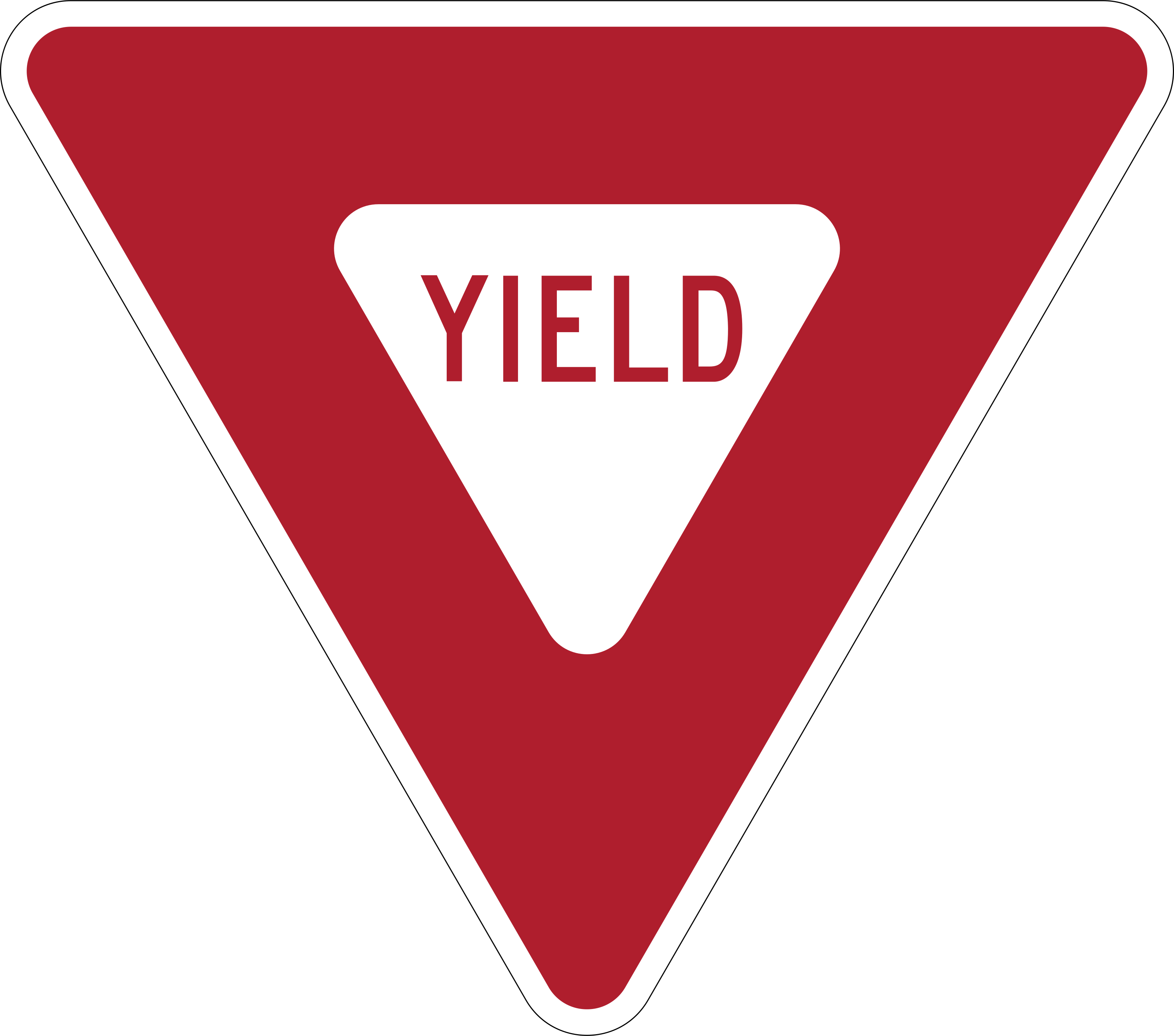
Correct answer: Slow down and let the traffic already there go first
That downward-pointing triangle is the yield sign: ease off, give up the right of way, and stop and wait if cross traffic makes stopping necessary.
Source: North Carolina Driver Handbook — Regulatory Signs
11. What is one advantage a plastic shatter-resistant face shield has over goggles?
Correct answer: It guards the whole face, not just the eyes
Unlike goggles, which guard only the eyes, a face shield helps protect the rider's entire face in a crash.
Source: NC Motorcyclists' Handbook — Wear the Right Gear
12. How does the steering feel when the front tire suddenly goes flat?
Correct answer: The steering feels heavy
A front-tire flat makes the steering feel heavy and is especially hazardous because it directly affects steering.
Source: NC Motorcyclists' Handbook — Mechanical Problems
13. Why should you keep well back from the vehicle ahead even while stopped?
Correct answer: So you can escape a rear threat or a vehicle rolling back
Leaving room while stopped makes it easier to move aside if someone bears down from behind, and gives you a cushion if the vehicle ahead rolls back.
Source: NC Motorcyclists' Handbook — Keeping Your Distance
14. When should a rider use turn signals?
Correct answer: Any time you plan to turn or change lanes, even if alone
Signal any time you intend to turn or change lanes, even if it seems no one is nearby, since your signals also help others notice you.
Source: NC Motorcyclists' Handbook — Increasing Conspicuity
15. If a car is positioned so it could enter your path, what should you assume?
Correct answer: That it will enter your path
Assume that if a car can pull into your path, it will, and be ready to take evasive action.
Source: NC Motorcyclists' Handbook — Intersections
16. Why is a motorcycle's brake light less noticeable than a car's?
Correct answer: It is smaller and blends with the always-on taillight
It is smaller and often competes with the taillight, which stays on with the headlight, so flashing it helps others notice you slowing.
Source: NC Motorcyclists' Handbook — Increasing Conspicuity
17. How should you park a motorcycle at a curb in North Carolina?
Correct answer: At a 90-degree angle with the rear wheel to the curb
Set the motorcycle at a right angle to the curb, with the back wheel resting against it.
Source: NC Motorcyclists' Handbook — Intersections
18. When a vehicle is passing you, where should you position yourself in your lane?
Correct answer: Hold the middle portion of your lane
Hold the middle of your lane while another vehicle goes by; drifting toward it would put you in a hazardous spot.
Source: NC Motorcyclists' Handbook — Keeping Your Distance
19. What is the point of rolling on the throttle as you travel through a turn?
Correct answer: To settle the suspension and hold the machine steady
Feeding in throttle settles the suspension, so hold a constant speed or build it gradually and the motorcycle stays steady all the way through.
Source: NC Motorcyclists' Handbook — Basic Vehicle Control
20. What is the best technique if you must stop quickly while leaned over in a curve?
Correct answer: Straighten the bike upright, then brake
The safest approach is to straighten the motorcycle upright first and then brake, since a leaned tire has less traction available for stopping.
Source: NC Motorcyclists' Handbook — Crash Avoidance