Free Louisiana DMV Motorcycle Practice Test 2026
The Louisiana Motorcycle knowledge test has ~25 questions, and you need ~20 correct (~80%) to pass. Practice free with questions written from the official Louisiana driver handbook — every one has a clear explanation, and you can retake as often as you like with no sign-up.
Content reviewed against official driver handbooks · August 12, 2026
What's on the Louisiana written test
The Louisiana Motorcycle knowledge test has ~25 questions; you need ~20 correct (~80%) to pass.
Based on the official Louisiana exam format — always confirm current details with your state DMV.
Practice by topic
Focus on one area at a time — each topic has its own set of Louisiana practice questions.
Helmets, eye protection, and abrasion-resistant gear — what the motorcycle handbook requires and why each piece matters in a crash.
Throttle, clutch, both brakes, and shifting — the controls you must operate smoothly before the road test.
Countersteering, the slow-look-press-roll technique, and choosing the right line through a curve at motorcycle speeds.
Using both brakes together, stopping quickly without locking a wheel, and recovering from a skid.
Where to position yourself in the lane to be seen, managing blind spots, and sharing the road safely with cars and trucks.
Conspicuity — reflective and bright clothing, headlight use, and lane position that make a rider easier for drivers to see.
Gravel, wet pavement, grooved roads, and railroad tracks — reading and handling surfaces that matter far more on two wheels.
Learn the shapes, colors, and meanings of regulatory, warning, and guide signs — from stop and yield to construction and school-zone signs.
Speed limits, turning and signaling rules, headlight and seat-belt requirements, and the everyday laws every driver must follow.
Who goes first at intersections, four-way stops, roundabouts, and crosswalks, and how to yield to pedestrians and emergency vehicles.
Blood alcohol limits, zero-tolerance and implied-consent laws, and how alcohol and drugs — legal or not — affect your driving.
How to read traffic signals, lane lines, and pavement markings — including yellow and white lines, arrows, and flashing lights.
Following distance, scanning, blind spots, using your lights, and the habits that prevent crashes and keep you in control.
Driving safely around motorcycles, bicycles, large trucks, pedestrians, and school buses — and knowing who has the right of way.
Legal and illegal parking, colored curbs, distances from hydrants and crossings, and how to park safely on hills.
Choosing a safe speed, keeping a space cushion, adjusting for weather and traffic, and understanding stopping distance.
What to do when things go wrong — brake failure, tire blowouts, skids, and stalling on railroad tracks.
The point system, license suspension, provisional-license rules, insurance requirements, and other licensing basics.
How to pass the first time
- Read the official Louisiana driver handbook at least once before test day.
- Practice by topic to find your weak spots, then fix them.
- Take full-length practice tests until you pass comfortably every time.
- Read every explanation — understanding beats memorizing.
Louisiana Motorcycle test — frequently asked questions
How many questions are on the Louisiana Motorcycle test?
The Louisiana Motorcycle knowledge test has ~25 questions, and you need ~20 correct (~80%) to pass. Our practice tests mirror that format.
How many questions can I miss on the Louisiana Motorcycle test?
You can miss up to ~5 of the ~25 questions and still pass — you need ~20 correct, which is ~80%.
Can I retake the practice test?
Yes — practice as often as you like, completely free. The questions and answer choices are shuffled each time.
Can I take the Louisiana practice test in Spanish?
Yes. Every question here is available in English and Spanish — switch languages anytime. Many states also offer the real knowledge test in languages other than English; confirm what Louisiana offers with your DMV.
Can I practice on my phone?
Yes. The practice tests work in any mobile or desktop browser — no app or sign-up needed — so you can study anywhere.
Are these the real DMV test questions?
No. Our questions are original, written from the current official Louisiana driver handbook to match the real test's topics and style. We are not affiliated with any DMV or government agency.
What's the best way to study?
Read the Louisiana driver handbook, practice by topic to target weak areas, and finish with full-length tests until you consistently pass.
Other Louisiana practice tests
Take the Motorcycle test in another state
Every Louisiana question is written from the official Louisiana driver handbook and checked against its current edition. DMV Test Free is a free, independent study resource — not affiliated with any DMV or government agency. About DMV Test Free
Louisiana Motorcycle questions with answers
20 sample questions from the Louisiana Motorcycle question bank — each with the correct answer, a short explanation, and the section of the official handbook it comes from.
Show all 20 questions with answers
1. A larger space cushion is especially needed when your motorcycle will:
Correct answer: Take longer than normal to stop
A larger cushion is required if the motorcycle will take longer than normal to stop, such as on slippery pavement.
Source: Louisiana Motorcycle Operator Manual - Keeping Your Distance (Following Another Vehicle)
2. A rider should check mirrors before slowing down because a following driver:
Correct answer: May not expect you to slow when or where you do
The driver behind may not expect you to slow, or may misjudge where you intend to slow, such as at a nearer driveway instead of a distant intersection.
Source: Louisiana Motorcycle Operator Manual - Increasing Conspicuity (Using Your Mirrors)
3. The very first mandatory requirement for Louisiana motorcyclists is that all riders must:
Correct answer: Wear an approved safety helmet
All riders must wear an approved safety helmet, listed as the first mandatory requirement for Louisiana motorcyclists.
Source: Louisiana Motorcycle Operator Manual - Mandatory Requirements for Louisiana Motorcyclists
4. What document does Louisiana require a motorcyclist to carry on their person while riding?
Correct answer: A basic operator's license with a motorcycle endorsement
A rider must carry a basic operator's license bearing the motorcycle endorsement.
Source: Louisiana Motorcycle Operator Manual - Mandatory Requirements for Louisiana Motorcyclists
5. The manual says that whether a rider is legally intoxicated is not the real issue because:
Correct answer: Impairment begins well below the legal limit
Impairment of judgment and skill begins well below the legal limit, so a rider can be affected even before reaching it.
Source: Louisiana Motorcycle Operator Manual - Alcohol and the Law
6. When parking a group of motorcycles, the manual suggests you avoid:
Correct answer: Parking downhill or head-in
Avoid parking downhill or head-in; where possible park so the group can pull through and depart smoothly in single file.
Source: Louisiana Motorcycle Operator Manual - Group Riding (Parking)
7. Why should a rider never rely on eye contact as proof that a driver will yield?
Correct answer: A driver may look right at you and still not see you
A driver can look directly at a motorcyclist and still fail to register them, so eye contact does not guarantee the driver will yield.
Source: Louisiana Motorcycle Operator Manual - Intersections
8. A small animal darts into your path while you are riding in traffic. What does the manual say?
Correct answer: Hold your lane, because striking something small beats colliding with a car
Avoiding an animal is worth doing only when it can be done safely; in traffic, dodging into another vehicle is by far the worse outcome.
Source: Louisiana Motorcycle Operator Manual - Animals
9. When does the manual say reflective, bright-colored gear should be worn?
Correct answer: In daylight and after dark alike
Most crashes take place in full daylight, so bright and reflective gear earns its keep around the clock rather than only after dark.
Source: Louisiana Motorcycle Operator Manual - Increasing Conspicuity (Clothing)
10. If vehicles are traveling on both sides of you, which lane position is usually best?
Correct answer: The center of the lane
When vehicles are on both sides, the center of the lane (path 2) is usually your best option.
Source: Louisiana Motorcycle Operator Manual - Keeping Your Distance (Lane Positions)
11. In a slow, tight turn the manual recommends counterbalancing by:
Correct answer: Leaning the motorcycle while keeping your body upright
In slow, tight turns you counterbalance by leaning the motorcycle only while keeping your body upright and straight.
Source: Louisiana Motorcycle Operator Manual - Turning
12. A street-legal motorcycle should, at minimum, be equipped with which of the following per the manual?
Correct answer: A headlight, taillight, brakelight, and two mirrors
At a minimum a street-legal motorcycle should have a headlight, taillight, brakelight, front and rear brakes, turn signals, a horn, and two mirrors.
Source: Louisiana Motorcycle Operator Manual - Know Your Motorcycle (The Right Motorcycle For You)
13. If the rear wheel locks and skids while the motorcycle is upright and traveling straight, the manual says you may:
Correct answer: Keep it locked until you have stopped
On a good-traction surface with the motorcycle upright and straight, you can keep the rear wheel locked until you have completely stopped.
Source: Louisiana Motorcycle Operator Manual - Crash Avoidance (Quick Stops)
14. When entering a freeway, using your turn signal early is helpful because:
Correct answer: Approaching drivers can see it and open room for you
Drivers approaching from behind are more likely to see the blinking signal and make room for you to merge.
Source: Louisiana Motorcycle Operator Manual - Increasing Conspicuity (Signals)
15. When an insect or pebble suddenly strikes you while riding, the manual says the most important thing to do is:
Correct answer: Keep your eyes on the road and hands on the bars
Whatever happens, keep your eyes on the road and your hands on the handlebars, then pull off when it is safe to deal with the problem.
Source: Louisiana Motorcycle Operator Manual - Flying Objects
16. A triangular sign turned so that its point faces sideways is used for what purpose?
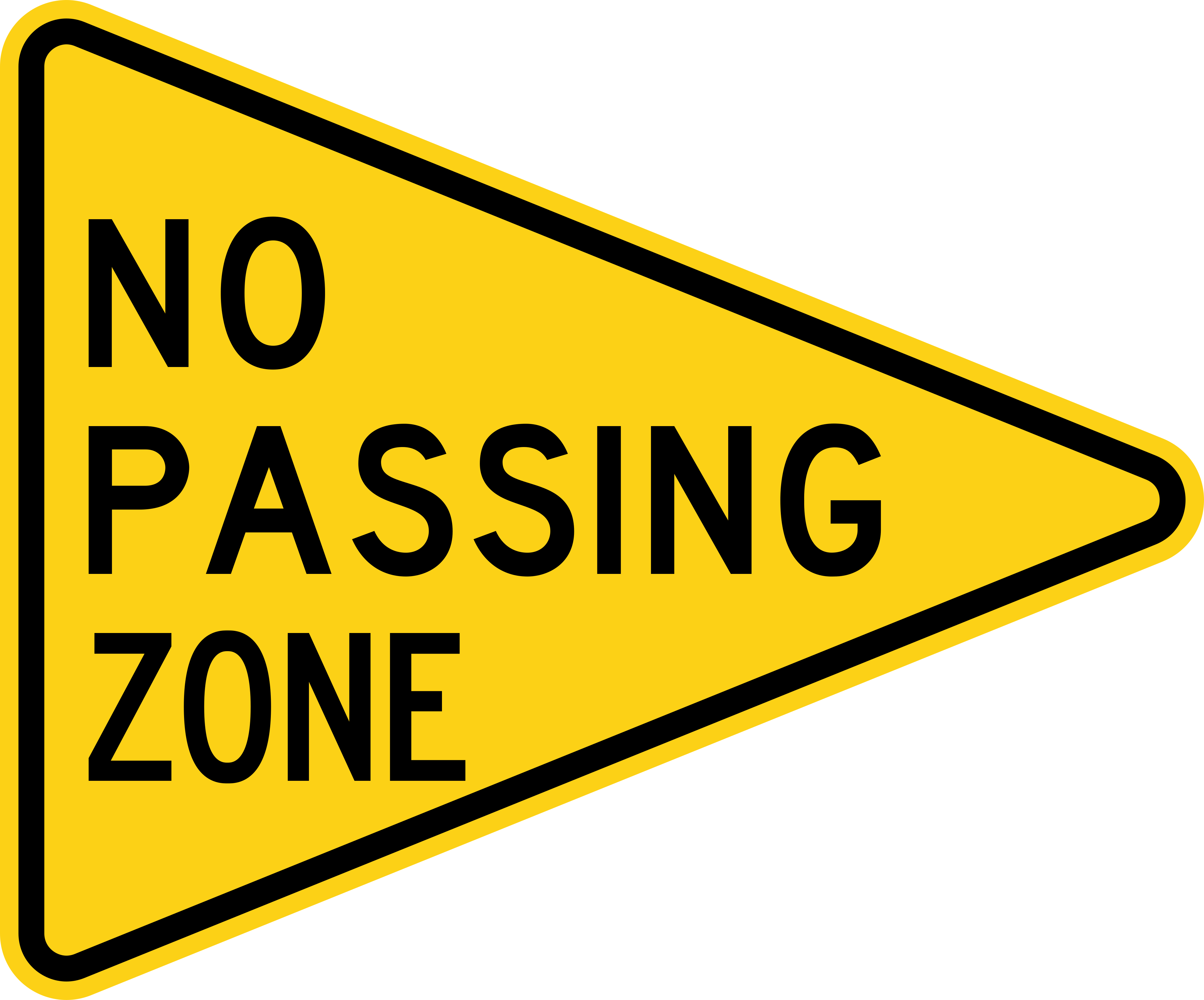
Correct answer: Marking a no-passing zone
A yield sign has its point down; the shape turned so the point aims to the side is reserved for marking stretches where overtaking is not allowed.
Source: Louisiana Class D & E Driver's Guide, Ch. 3 - Sign Shapes
17. What is an anti-lock braking system designed to do?
Correct answer: Keep a wheel from locking during a hard straight-line stop
Sensors watch for an approaching lock-up and release then restore hydraulic pressure many times each second, which keeps braking strong without a skid.
Source: Louisiana Motorcycle Operator Manual - Basic Vehicle Control (Anti-Lock Braking Systems)
18. Why does the manual object to calling a traffic collision an 'accident'?
Correct answer: Because most people involved in one share some of the responsibility
The word suggests nobody was at fault, but the manual points out that in traffic almost everyone caught up in a crash contributed something to it.
Source: Louisiana Motorcycle Operator Manual - Know Your Responsibilities
19. When the pavement is slippery or you cannot see through the vehicle ahead, the manual says to open your following distance to at least:
Correct answer: Three seconds or more
Open up a three-second or larger following distance when the road is slippery, you can't see past the vehicle ahead, or someone may cut in.
Source: Louisiana Motorcycle Operator Manual - Keeping Your Distance (Following Another Vehicle)
20. On a two-lane highway, how should a staggered group get past slower traffic?
Correct answer: One rider at a time, each judging the oncoming traffic personally
Each rider has to judge the gap fresh, because oncoming conditions can change between the leader's pass and the next rider's turn.
Source: Louisiana Motorcycle Operator Manual - Group Riding (Passing in Formation)