Free New York DMV Motorcycle Practice Test 2026
The New York Motorcycle knowledge test has 20 questions, and you need 14 correct (70%) to pass. Practice free with questions written from the official New York driver handbook — every one has a clear explanation, and you can retake as often as you like with no sign-up.
Content reviewed against official driver handbooks · August 12, 2026
What's on the New York written test
The New York Motorcycle knowledge test has 20 questions; you need 14 correct (70%) to pass.
Based on the official New York exam format — always confirm current details with your state DMV.
Practice by topic
Focus on one area at a time — each topic has its own set of New York practice questions.
Helmets, eye protection, and abrasion-resistant gear — what the motorcycle handbook requires and why each piece matters in a crash.
Throttle, clutch, both brakes, and shifting — the controls you must operate smoothly before the road test.
Countersteering, the slow-look-press-roll technique, and choosing the right line through a curve at motorcycle speeds.
Using both brakes together, stopping quickly without locking a wheel, and recovering from a skid.
Where to position yourself in the lane to be seen, managing blind spots, and sharing the road safely with cars and trucks.
Conspicuity — reflective and bright clothing, headlight use, and lane position that make a rider easier for drivers to see.
Gravel, wet pavement, grooved roads, and railroad tracks — reading and handling surfaces that matter far more on two wheels.
Speed limits, turning and signaling rules, headlight and seat-belt requirements, and the everyday laws every driver must follow.
Blood alcohol limits, zero-tolerance and implied-consent laws, and how alcohol and drugs — legal or not — affect your driving.
How to pass the first time
- Read the official New York driver handbook at least once before test day.
- Practice by topic to find your weak spots, then fix them.
- Take full-length practice tests until you pass comfortably every time.
- Read every explanation — understanding beats memorizing.
New York Motorcycle test — frequently asked questions
How many questions are on the New York Motorcycle test?
The New York Motorcycle knowledge test has 20 questions, and you need 14 correct (70%) to pass. Our practice tests mirror that format.
How many questions can I miss on the New York Motorcycle test?
You can miss up to 6 of the 20 questions and still pass — you need 14 correct, which is 70%.
Can I retake the practice test?
Yes — practice as often as you like, completely free. The questions and answer choices are shuffled each time.
Can I take the New York practice test in Spanish?
Yes. Every question here is available in English and Spanish — switch languages anytime. Many states also offer the real knowledge test in languages other than English; confirm what New York offers with your DMV.
Can I practice on my phone?
Yes. The practice tests work in any mobile or desktop browser — no app or sign-up needed — so you can study anywhere.
Are these the real DMV test questions?
No. Our questions are original, written from the current official New York driver handbook to match the real test's topics and style. We are not affiliated with any DMV or government agency.
What's the best way to study?
Read the New York driver handbook, practice by topic to target weak areas, and finish with full-length tests until you consistently pass.
Other New York practice tests
Take the Motorcycle test in another state
Every New York question is written from the official New York driver handbook and checked against its current edition. DMV Test Free is a free, independent study resource — not affiliated with any DMV or government agency. About DMV Test Free
New York Motorcycle questions with answers
20 sample questions from the New York Motorcycle question bank — each with the correct answer, a short explanation, and the section of the official handbook it comes from.
Show all 20 questions with answers
1. When loading cargo on a motorcycle, you should:
Correct answer: Keep the load low, balanced, and tightly secured
Keep the load low — on the tank or in the saddlebags — secure it tightly so it cannot shift, and spread the weight evenly on both sides. A high or loose load raises the center of gravity and can upset the motorcycle's balance.
Source: New York State Motorcycle Manual — Carrying Passengers and Cargo
2. A friend claims a can of beer before a ride is safer than a mixed drink made with one shot of liquor. Is that claim correct?
Correct answer: No — beer, a single-shot mixed drink, a glass of wine and a wine cooler all carry about the same alcohol
A 12-ounce beer, a mixed drink built on a single shot, a 5-ounce pour of wine and a 12-ounce cooler are equivalent in alcohol content. Changing which glass you hold changes nothing about how impaired you end up.
Source: New York State Motorcycle Manual — Blood Alcohol Concentration
3. The manual tells you to begin with your right wrist held flat on the throttle. What does that accomplish?
Correct answer: It makes it harder to feed in more throttle than you intended
A flat wrist limits how far the grip can be twisted, so a bump or a startled grab does not turn into a surge of power. Sitting far enough forward to keep your arms slightly bent serves the same purpose.
4. You are riding straight through an intersection, and an oncoming car is waiting to turn left across your path. You should:
Correct answer: Slow down, cover your brakes, and be ready to stop or take evasive action
Left-turning cars are the biggest intersection danger for riders. Never assume the driver sees you. Slow down, cover both brakes, choose a lane position that keeps you visible, and be ready to stop or swerve if the car turns.
5. When is the best moment to change gears for a turn?
Correct answer: Before you enter it
Settle the gear on the approach so the corner itself can be spent on your line. If a mid-corner shift becomes unavoidable, make it as smooth as you possibly can, because an abrupt change in power at the rear wheel can break traction.
6. How should the front brake lever be applied during a hard stop?
Correct answer: Squeezed firmly and progressively
Building pressure smoothly lets weight shift forward and load the front tire before you ask it for everything it has. Snatching at the lever skips that step and can lock the wheel.
7. When should tinted goggles or a tinted face shield be left at home?
Correct answer: After dark, or any time there is little light to work with
A tint steals light from your eyes, which is the last thing you can spare after dark or in gloom. Keep tinted lenses for bright conditions and carry a clear set for everything else.
Source: New York State Motorcycle Manual — Eye and Face Protection
8. When is it most worth flashing your brake light before you slow down?
Correct answer: When you are slowing somewhere drivers would not expect it, such as partway down a block or at an alley
A motorcycle's brake light is easy to overlook, especially with the taillight already burning. A flash warns drivers who have no reason to expect you to slow — turning off a fast road, or stopping partway down a block — and it also nudges a tailgater to back away.
9. What does New York State law require regarding motorcycle helmets?
Correct answer: Every rider and passenger must wear a DOT-approved helmet
New York has a universal helmet law: the operator and any passenger must wear a helmet that meets U.S. DOT standards, on every ride. There is no age exception — everyone on the motorcycle must be helmeted.
10. A 'Slippery When Wet' warning sign is especially important to a motorcyclist because:

Correct answer: Reduced traction affects a two-wheeled vehicle even more
With only two tires, a motorcycle depends heavily on traction. A slippery surface can cause a skid quickly, so slow down, avoid sudden braking or steering, and increase your following distance when the pavement may be slick.
Source: New York State Motorcycle Manual — Handling Dangerous Surfaces
11. A car is waiting to pull out from a side street on your right. Which lane position usually makes you most visible and gives you the most space?
Correct answer: The center or left portion of your lane
Moving away from the right edge — toward the center or left of your lane — puts you where the waiting driver is more likely to see you and buys room if they pull out. Hugging the right edge hides you and leaves little space to react.
12. At what blood alcohol concentration is a driver or rider treated as legally intoxicated in New York State?
Correct answer: .08 percent
New York draws the intoxication line at .08 percent. Other states set theirs at different figures, and riding skill starts to erode well before any of those numbers is reached.
Source: New York State Motorcycle Manual — Alcohol and the Law
13. If the throttle stays stuck open and twisting it back and forth does not free it, what should you do?
Correct answer: Squeeze the clutch and turn off the engine cut-off switch
If the throttle sticks, first try twisting it back and forth. If that fails, squeeze in the clutch and use the engine cut-off (kill) switch to stop power to the rear wheel, then brake and pull safely off the road.
Source: New York State Motorcycle Manual — Mechanical Problems
14. Rain has just begun to fall. Which part of the lane is generally the better place to be?
Correct answer: The wheel paths the cars ahead have swept, often the left one
The middle strip gathers oil and grease and turns treacherous the moment it is wet. The paths the cars ahead have swept are cleaner, and the left of the two is often the pick, though traffic and road conditions can send you elsewhere.
Source: New York State Motorcycle Manual — Slippery Surfaces
15. No other traffic is around as you come up on a curve. Which line through it opens up your view and eases the arc?
Correct answer: Begin at the outside, work toward the inside, then drift back out on the way out
Beginning wide stretches how far you can see into the bend and flattens the arc you have to steer. From there you move in toward the inside, then let the motorcycle run back out toward the far side as the corner releases you.
16. An object suddenly appears in your path and you are too close to stop in time. Your best option is usually to:
Correct answer: Swerve around the object
When there is not enough room to stop, swerve around the object instead. Press on the handgrip in the direction you want to go for a quick, smooth turn, and keep the motorcycle upright — do not brake while you are swerving.
Source: New York State Motorcycle Manual — Swerving or Turning Quickly
17. How should a riding jacket and riding pants fit?
Correct answer: Close enough that they will not flap in the wind, yet free enough to let you move
Sleeves and legs should cover you completely and sit close to the body, since fabric that flaps wears you out and can snag — but never so close that reaching the controls becomes a struggle. Leather gives the best protection, with heavy synthetics not far behind.
18. Why should riders be cautious of painted lane markings and steel surfaces when the road is wet?
Correct answer: They can be more slippery than the surrounding road
Painted lines, manhole covers, steel plates, and bridge gratings offer less grip than pavement, especially when wet. Try not to ride directly on them while braking or turning, and cross them with the motorcycle as upright as possible.
Source: New York State Motorcycle Manual — Handling Dangerous Surfaces
19. The manual recommends that a group of riders switch from a staggered formation to single file when:
Correct answer: Going through curves and turns or entering and leaving a highway
Ride single file through curves and turns, and when entering or leaving a highway. Those situations need each rider to have the full lane and a clear path, so the staggered formation is set aside until the road opens up again.
20. You see a warning sign showing a motorcycle above the words 'GROOVED PAVEMENT.' What does it mean for you?
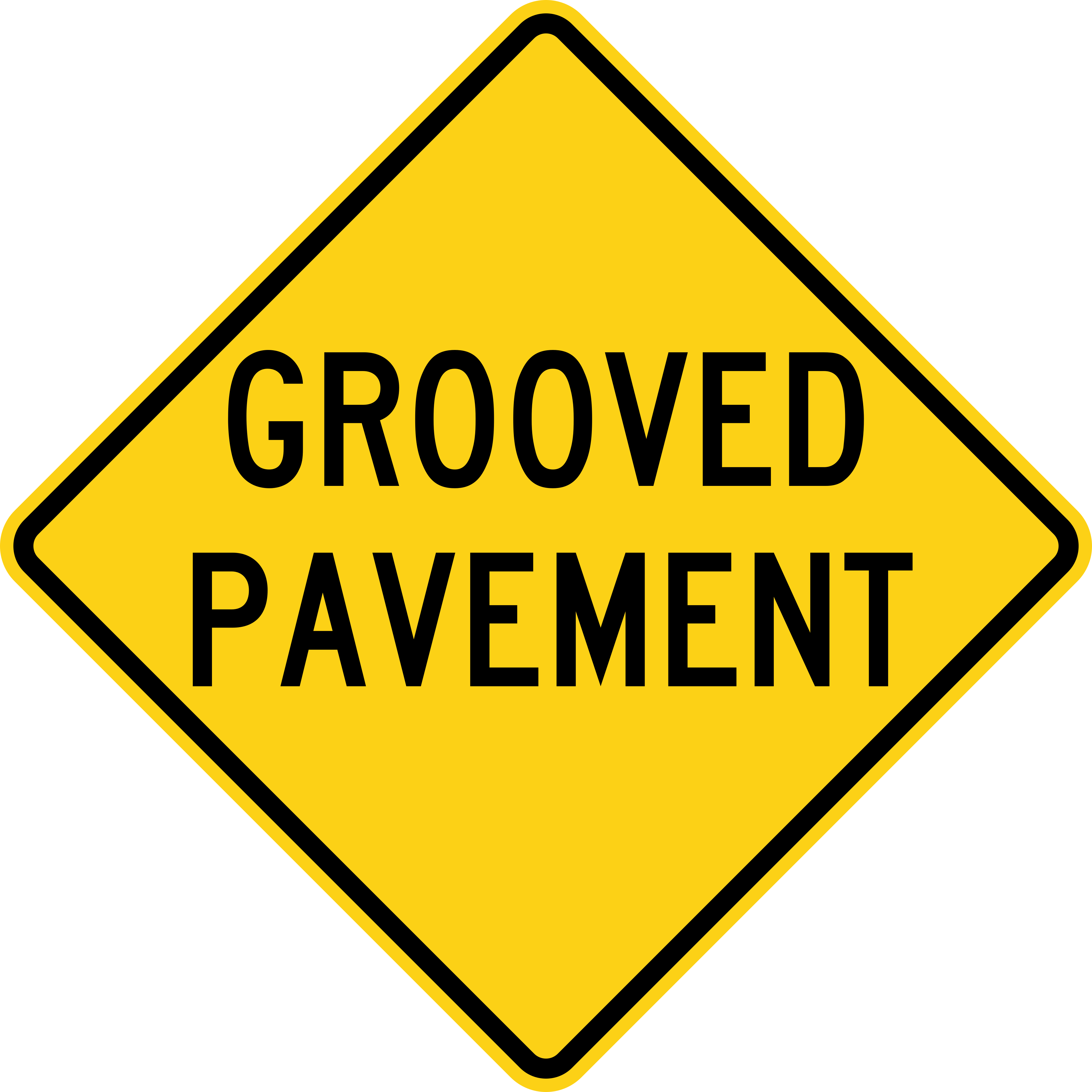
Correct answer: The pavement ahead has grooves that can make the motorcycle feel unstable
Grooved pavement and metal-grate surfaces can make a motorcycle wander or weave, which feels unsettling but is usually not dangerous. Keep a relaxed but firm grip, ride straight across, and don't fight the slight side-to-side motion.
Source: New York State Motorcycle Manual — Handling Dangerous Surfaces