Free Washington DMV Car / Permit Practice Test 2026
The Washington Car / Permit knowledge test has 40 questions, and you need 32 correct (80%) to pass. Practice free with questions written from the official Washington driver handbook — every one has a clear explanation, and you can retake as often as you like with no sign-up.
Content reviewed against official driver handbooks · August 12, 2026
What's on the Washington written test
The Washington Car / Permit knowledge test has 40 questions; you need 32 correct (80%) to pass.
Based on the official Washington exam format — always confirm current details with your state DMV.
Practice by topic
Focus on one area at a time — each topic has its own set of Washington practice questions.
Learn the shapes, colors, and meanings of regulatory, warning, and guide signs — from stop and yield to construction and school-zone signs.
Speed limits, turning and signaling rules, headlight and seat-belt requirements, and the everyday laws every driver must follow.
How to read traffic signals, lane lines, and pavement markings — including yellow and white lines, arrows, and flashing lights.
Who goes first at intersections, four-way stops, roundabouts, and crosswalks, and how to yield to pedestrians and emergency vehicles.
Following distance, scanning, blind spots, using your lights, and the habits that prevent crashes and keep you in control.
Driving safely around motorcycles, bicycles, large trucks, pedestrians, and school buses — and knowing who has the right of way.
Blood alcohol limits, zero-tolerance and implied-consent laws, and how alcohol and drugs — legal or not — affect your driving.
Legal and illegal parking, colored curbs, distances from hydrants and crossings, and how to park safely on hills.
Choosing a safe speed, keeping a space cushion, adjusting for weather and traffic, and understanding stopping distance.
What to do when things go wrong — brake failure, tire blowouts, skids, and stalling on railroad tracks.
The point system, license suspension, provisional-license rules, insurance requirements, and other licensing basics.
How to pass the first time
- Read the official Washington driver handbook at least once before test day.
- Practice by topic to find your weak spots, then fix them.
- Take full-length practice tests until you pass comfortably every time.
- Read every explanation — understanding beats memorizing.
Washington Car / Permit test — frequently asked questions
How many questions are on the Washington Car / Permit test?
The Washington Car / Permit knowledge test has 40 questions, and you need 32 correct (80%) to pass. Our practice tests mirror that format.
How many questions can I miss on the Washington Car / Permit test?
You can miss up to 8 of the 40 questions and still pass — you need 32 correct, which is 80%.
Can I retake the practice test?
Yes — practice as often as you like, completely free. The questions and answer choices are shuffled each time.
Can I take the Washington practice test in Spanish?
Yes. Every question here is available in English and Spanish — switch languages anytime. Many states also offer the real knowledge test in languages other than English; confirm what Washington offers with your DMV.
Can I practice on my phone?
Yes. The practice tests work in any mobile or desktop browser — no app or sign-up needed — so you can study anywhere.
Are these the real DMV test questions?
No. Our questions are original, written from the current official Washington driver handbook to match the real test's topics and style. We are not affiliated with any DMV or government agency.
What's the best way to study?
Read the Washington driver handbook, practice by topic to target weak areas, and finish with full-length tests until you consistently pass.
Other Washington practice tests
Take the Car / Permit test in another state
Every Washington question is written from the official Washington driver handbook and checked against its current edition. DMV Test Free is a free, independent study resource — not affiliated with any DMV or government agency. About DMV Test Free
Washington Car / Permit questions with answers
20 sample questions from the Washington Car / Permit question bank — each with the correct answer, a short explanation, and the section of the official handbook it comes from.
Show all 20 questions with answers
1. At a mid-block crosswalk, what should drivers do for pedestrians and bicyclists crossing?
Correct answer: Stop and allow them to cross
In a marked crosswalk, a walker is always given priority. Come to a stop and let people and cyclists cross, whether or not a stop sign is posted there.
Source: Washington Driver Guide — Mid-block crossing (4.14)
2. What does Washington law say about carpool (HOV) lanes and passing?
Correct answer: They are not passing lanes and require meeting occupancy rules
Carpool lanes are not passing lanes. They are reserved for vehicles that meet the posted occupancy requirement, plus motorcycles.
Source: Washington Driver Guide — General Driving Guidance (4.10)
3. A blue sign showing a fork and knife is posted ahead. What does it mean?

Correct answer: Restaurants or food services are available nearby.
Restaurants or food services are available nearby. (This is the "Food" sign.)
Source: Washington Driver Guide — Traffic Signs
4. How are bicyclists who are riding in a crosswalk treated under Washington rules?
Correct answer: As pedestrians you must yield to
A rider using a crosswalk is treated as a pedestrian. Give way to them at crossings and intersections, whether or not any lines are painted on the pavement.
Source: Washington Driver Guide — Sharing with Bicyclists (4.6)
5. For a Washington driver who is 21 or older, what blood alcohol concentration (BAC) is considered driving under the influence?
Correct answer: 0.08% or higher
For drivers 21 and older, a BAC of 0.08% or higher is a DUI and can bring legal consequences. Younger drivers face a much lower limit.
Source: Washington Driver Guide — Blood Alcohol Concentration (1.15)
6. If your address changes, how soon must you update it in License Express?
Correct answer: Within 10 days
Report an address change in License Express no later than 10 days after it happens. A name change, by contrast, has to be handled at a driver licensing office.
Source: Washington Driver Guide — Change of Address or Name (1.16)
7. What do double solid white lines between lanes mean?
Correct answer: They act as a barrier you cannot legally cross
Double solid white lines form a barrier between lanes. It is illegal to cross them, so you must stay in your lane.
Source: Washington Driver Guide — Road Markings (4.16)
8. When you park on a hill where there is no curb, which way should you point your front wheels?
Correct answer: Toward the edge of the road
Where there is no curb, angle the front tires toward the road's outer edge. If the car rolls, it drifts away from traffic instead of into it.
Source: Washington Driver Guide — Parking on a Hill (4.18)
9. Flashing red lights and ringing bells are active at a railroad crossing. Where must you stop?
Correct answer: Between 15 and 50 feet from the nearest rail
Stop somewhere between 15 and 50 feet from the closest rail. Never steer around a lowered gate, and never race a train to the crossing.
Source: Washington Driver Guide — Sharing the Road with Trains (4.7)
10. What advantage does an antilock braking system (ABS) give during hard braking?
Correct answer: It lets you keep steering control while braking hard
ABS will not reduce how far it takes to stop, but by preventing the wheels from locking it lets you keep steering while braking hard.
Source: Washington Driver Guide — Antilock Braking Systems (2.8)
11. How does a zipper merge improve driving conditions when a lane is closing?
Correct answer: It improves flow and creates a predictable, safer merge
Zipper merging uses both lanes until the merge point, where drivers alternate like teeth of a zipper. It improves traffic flow by about 60 percent and reduces sudden lane changes.
Source: Washington Driver Guide — Zipper Merging (5.3)
12. What must you do when an emergency vehicle approaches with lights and siren active?
Correct answer: Pull to the right and stop until it passes
An emergency vehicle running lights or a siren has priority. Steer to the right edge, come to a stop until it goes by, then merge back in your original order.
Source: Washington Driver Guide — Sharing with Emergency Vehicles (4.9)
13. In Washington, who has the authority to override a traffic signal and direct traffic?
Correct answer: Officers, road workers, and school crossing guards
Law enforcement, construction and maintenance workers, and school crossing guards can direct traffic, and their instructions must be followed even over signals.
Source: Washington Driver Guide — Traffic Control Devices (4.10)
14. A blue sign with a white letter 'H' is posted ahead. What does it mean?
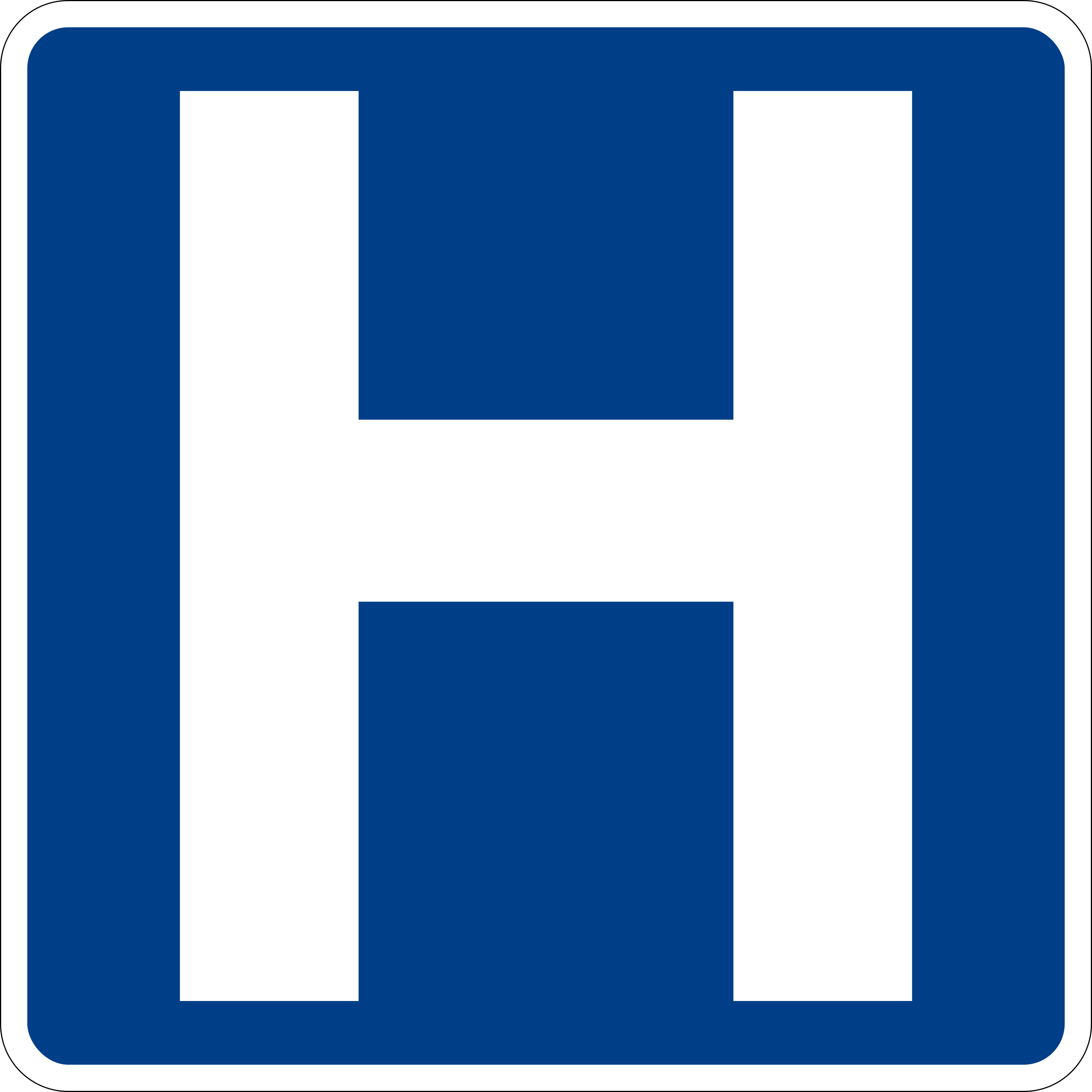
Correct answer: A hospital with emergency medical services is nearby.
A hospital with emergency medical services is nearby. (This is the "Hospital" sign.)
Source: Washington Driver Guide — Traffic Signs
15. What happens to fines for a driver who illegally passes a stopped school bus in Washington?
Correct answer: They are doubled
Anyone who drives past a stopped school bus faces a doubled fine. The steeper penalty reflects the danger to kids getting on and off.
Source: Washington Driver Guide — Sharing with School Buses (4.2)
16. What BAC level can bring DUI consequences for a Washington driver under age 21?
Correct answer: 0.02% or more
Drivers under 21 face the same potential consequences at a BAC of just 0.02% or more. The limit is far lower because underage drinking and driving is not tolerated.
Source: Washington Driver Guide — Blood Alcohol Concentration (1.15)
17. Which exam must a new Washington driver pass first?
Correct answer: The Driving Knowledge Exam
The knowledge test has to be cleared first; only then may you attempt the skills test. Once the knowledge portion is passed, a two-year window opens to finish the skills exam.
Source: Washington Driver Guide — Two Exams (1.12)
18. After you make a complete stop at a red light in Washington and no sign forbids it, what turn is generally allowed?
Correct answer: A right turn, or a left turn onto a one-way street
Once fully stopped and with room to merge safely, you may turn right, or turn left onto a one-way street, unless a no turn on red sign is posted.
Source: Washington Driver Guide — Traffic Light Signals (4.11)
19. How close to a railroad crossing does Washington prohibit parking?
Correct answer: Within 50 feet
Do not park within 50 feet of a railroad crossing. Parking closer could block sightlines or the path near the tracks.
Source: Washington Driver Guide — General Parking Rules (4.18)
20. According to the Washington guide, collisions typically have which three causes?
Correct answer: Too much speed, too little space, and poor situational awareness
Most collisions come down to too much speed, too little space, and insufficient situational awareness. Managing these three greatly reduces crash risk.
Source: Washington Driver Guide — Collisions (5.9)