Free Texas DMV Motorcycle Practice Test 2026
The Texas Motorcycle knowledge test has ~20 questions, and you need ~16 correct (~80%) to pass. Practice free with questions written from the official Texas driver handbook — every one has a clear explanation, and you can retake as often as you like with no sign-up.
Content reviewed against official driver handbooks · August 12, 2026
What's on the Texas written test
The Texas Motorcycle knowledge test has ~20 questions; you need ~16 correct (~80%) to pass.
Based on the official Texas exam format — always confirm current details with your state DMV.
Prefer to study on paper?
We make and sell this edition ourselves — it is our own product, not a partner's, and nobody paid us to show it to you. Everything inside it is also free to read on this site; what you are buying is the printable format.
Study offline
Texas Practice Test Pack — 2026 Printable Edition
All 417 Texas practice questions with worked explanations and answer keys — car, motorcycle, CDL and air brakes, in English and Spanish. Eight print-ready PDFs, 605 pages; the car and CDL editions add 146 cut-out road-sign flashcards.
Get the printable edition — $4.99- One-time purchase
- Instant download
- 14-day refund
Practice by topic
Focus on one area at a time — each topic has its own set of Texas practice questions.
Helmets, eye protection, and abrasion-resistant gear — what the motorcycle handbook requires and why each piece matters in a crash.
Throttle, clutch, both brakes, and shifting — the controls you must operate smoothly before the road test.
Countersteering, the slow-look-press-roll technique, and choosing the right line through a curve at motorcycle speeds.
Using both brakes together, stopping quickly without locking a wheel, and recovering from a skid.
Where to position yourself in the lane to be seen, managing blind spots, and sharing the road safely with cars and trucks.
Conspicuity — reflective and bright clothing, headlight use, and lane position that make a rider easier for drivers to see.
Gravel, wet pavement, grooved roads, and railroad tracks — reading and handling surfaces that matter far more on two wheels.
Speed limits, turning and signaling rules, headlight and seat-belt requirements, and the everyday laws every driver must follow.
Who goes first at intersections, four-way stops, roundabouts, and crosswalks, and how to yield to pedestrians and emergency vehicles.
Blood alcohol limits, zero-tolerance and implied-consent laws, and how alcohol and drugs — legal or not — affect your driving.
How to pass the first time
- Read the official Texas driver handbook at least once before test day.
- Practice by topic to find your weak spots, then fix them.
- Take full-length practice tests until you pass comfortably every time.
- Read every explanation — understanding beats memorizing.
Texas Motorcycle test — frequently asked questions
How many questions are on the Texas Motorcycle test?
The Texas Motorcycle knowledge test has ~20 questions, and you need ~16 correct (~80%) to pass. Our practice tests mirror that format.
How many questions can I miss on the Texas Motorcycle test?
You can miss up to ~4 of the ~20 questions and still pass — you need ~16 correct, which is ~80%.
Can I retake the practice test?
Yes — practice as often as you like, completely free. The questions and answer choices are shuffled each time.
Can I take the Texas practice test in Spanish?
Yes. Every question here is available in English and Spanish — switch languages anytime. Many states also offer the real knowledge test in languages other than English; confirm what Texas offers with your DMV.
Can I practice on my phone?
Yes. The practice tests work in any mobile or desktop browser — no app or sign-up needed — so you can study anywhere.
Are these the real DMV test questions?
No. Our questions are original, written from the current official Texas driver handbook to match the real test's topics and style. We are not affiliated with any DMV or government agency.
What's the best way to study?
Read the Texas driver handbook, practice by topic to target weak areas, and finish with full-length tests until you consistently pass.
Other Texas practice tests
Take the Motorcycle test in another state
Every Texas question is written from the official Texas driver handbook and checked against its current edition. DMV Test Free is a free, independent study resource — not affiliated with any DMV or government agency. About DMV Test Free
Texas Motorcycle questions with answers
20 sample questions from the Texas Motorcycle question bank — each with the correct answer, a short explanation, and the section of the official handbook it comes from.
Show all 20 questions with answers
1. Bushes hide the cross traffic at a stop sign. After you stop at the stop line, what comes next?
Correct answer: Edge ahead, stop a second time just short of the cross lane, and lean forward to look
A second stop at the very edge of the crossing traffic lets you lean out and look past the bushes, while your front wheel still stays clear of the lane other drivers are using.
2. Under Texas 'implied consent,' what happens if you refuse a lawful breath or blood test after being arrested for riding while intoxicated?
Correct answer: Your driver license is automatically suspended
By operating on Texas roads you agree to chemical testing if you are lawfully arrested. Refusing the test leads to an automatic driver license suspension, separate from any criminal penalty.
Source: Texas Motorcycle Operator's Manual — Implied Consent
3. If you accidentally lock the rear brake and the rear wheel begins to skid in a straight line, you should:
Correct answer: Keep the rear brake locked until you have stopped, as long as you are moving straight
If the rear wheel is already skidding in a straight line, keep the rear brake applied until you stop. Suddenly releasing a locked rear wheel while it is out of line can throw you off.
Source: Texas Motorcycle Operator's Manual — Rear-Wheel Skids
4. What is the purpose of a pre-ride inspection (often remembered as T-CLOCS)?
Correct answer: To check the motorcycle's key systems before riding so you can fix problems early
T-CLOCS (Tires, Controls, Lights, Oil and fluids, Chassis, Stands) reminds you to check the bike's key systems before each ride, catching trouble before it becomes dangerous.
Source: Texas Motorcycle Operator's Manual — Pre-Ride Inspection
5. What causes many of the crashes in which a motorcycle leaves the road on a curve with no other vehicle involved?
Correct answer: Running wide because the bend was taken faster than the rider could hold
Riders who arrive too fast run wide and meet a fixed object or the oncoming lane. Read each bend before you commit: some hold a steady radius, some open up, some tighten, and some come in a series.
6. A 15-year-old holds a Texas motorcycle license. What is that rider allowed to operate?
Correct answer: Only a motorcycle of 250cc piston displacement or less
A rider licensed before turning 16 carries restriction code I, which caps engine displacement at 250cc. The cap can be lifted once the rider reaches 16.
Source: Texas Motorcycle Operator's Manual — Requirements for Licensing Minors
7. Why do riders often avoid the center strip of a traffic lane, especially when it starts to rain?
Correct answer: Oil and grease collect there and can be slippery when wet
Oil and grease dripped by cars build up in the center of the lane. That strip can be slippery, particularly during the first minutes of rain before it washes away.
Source: Texas Motorcycle Operator's Manual — Surface Hazards
8. How can you warn a driver following closely behind that you are about to slow or stop?
Correct answer: Flash your brake light by tapping the brake a few times
Tap the brake lightly a few times so the brake light flashes. A flashing brake light draws more attention than a steady one, which helps in heavy or fast-moving traffic.
9. When should you increase your following distance beyond the 2-second minimum?
Correct answer: In rain, on slippery roads, at night, or when someone is following you too closely
Poor traction and reduced visibility increase the distance you need to stop. Open up to three or four seconds or more in rain, at night, on slippery roads, or when a tailgater is behind you.
Source: Texas Motorcycle Operator's Manual — Adjusting Your Space Cushion
10. Orange signs placed along a road tell you that you are:
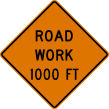
Correct answer: In or approaching a construction or work zone
Orange is the color for construction and maintenance zones. Watch for workers, uneven pavement, loose gravel, and sudden stops, all of which are extra risky on a motorcycle.
11. What protective equipment should your passenger be wearing?
Correct answer: The same standard of protective equipment that the rider wears
A passenger meets the same road, weather and crash forces you do, so equip them to the same standard before the trip starts rather than after something happens.
Source: Texas Motorcycle Operator's Manual — Equipment for Carrying a Passenger
12. You are in the right-hand lane of a highway and cars are coming down an entrance ramp ahead. You should:
Correct answer: Change lanes if one is clear, or adjust your speed to open a gap for them
A driver hunting for a gap on a ramp may never pick a motorcycle out of the traffic stream. Moving over or opening a gap costs you nothing and removes the conflict before it forms.
13. In Texas, an adult 21 or older is considered legally intoxicated to operate a motorcycle at a blood alcohol concentration of:
Correct answer: 0.08 percent
For operators 21 and older, the legal limit in Texas is a blood alcohol concentration of 0.08 percent. You can still be arrested below that level if alcohol has impaired your riding.
Source: Texas Motorcycle Operator's Manual — Alcohol and the Law
14. What is the correct way to work the front brake lever during a hard stop?
Correct answer: Squeeze it steadily, adding force as the stop develops
A progressive squeeze lets weight settle onto the front tire, and the grip that arrives with it lets you pull harder as the stop develops. Snatching at the lever simply locks the wheel.
15. Riding through a shopping district or a school zone, what shortens the time you need to react?
Correct answer: Covering the clutch lever and both brake controls as you ride
Keeping your fingers over the clutch lever and both brakes ready removes the fraction of a second spent reaching for them, which is worth having where cars and people appear without warning.
16. Where should you direct your eyes as you ride through a curve?
Correct answer: Through the turn toward where you want to go
Look through the turn toward where you want to go. A motorcycle tends to go where you look, so keeping your eyes up and ahead helps you hold your line.
17. What is the recommended way to park a motorcycle next to a curb?
Correct answer: At an angle, with the rear wheel to the curb
Park at an angle with the rear wheel to the curb. This keeps the motorcycle stable, clear of the flow of traffic, and easy to roll back out when you leave.
18. When is pavement often most slippery, and where can a rider find better traction in the rain?
Correct answer: Most slippery when rain first starts; ride in the tire tracks left by other vehicles
Roads are usually most slippery right after rain begins, when water lifts built-up oil. Riding in the drier tracks left by the vehicles ahead can give you a little more grip.
Source: Texas Motorcycle Operator's Manual — Riding in the Rain
19. Why do drivers so often pull out in front of an approaching motorcycle?
Correct answer: A narrow vehicle looks farther away and slower than it really is
Size fools the eye. A narrow silhouette reads as farther off and slower than it truly is, so the driver believes there is time to go, and there is not.
Source: Texas Motorcycle Operator's Manual — Increasing Conspicuity
20. How should you choose your position within a traffic lane?
Correct answer: Pick the position that helps you see, be seen, and keep a space cushion, and change it as conditions change
There is no single best position. Choose the part of the lane that gives you the best view, makes you most visible, and keeps a space cushion around you, and change it as traffic and the road change.