Free South Carolina DMV Car / Permit Practice Test 2026
The South Carolina Car / Permit knowledge test has ~30 questions, and you need ~24 correct (~80%) to pass. Practice free with questions written from the official South Carolina driver handbook — every one has a clear explanation, and you can retake as often as you like with no sign-up.
Content reviewed against official driver handbooks · August 12, 2026
What's on the South Carolina written test
The South Carolina Car / Permit knowledge test has ~30 questions; you need ~24 correct (~80%) to pass.
Based on the official South Carolina exam format — always confirm current details with your state DMV.
Practice by topic
Focus on one area at a time — each topic has its own set of South Carolina practice questions.
Learn the shapes, colors, and meanings of regulatory, warning, and guide signs — from stop and yield to construction and school-zone signs.
Speed limits, turning and signaling rules, headlight and seat-belt requirements, and the everyday laws every driver must follow.
How to read traffic signals, lane lines, and pavement markings — including yellow and white lines, arrows, and flashing lights.
Who goes first at intersections, four-way stops, roundabouts, and crosswalks, and how to yield to pedestrians and emergency vehicles.
Following distance, scanning, blind spots, using your lights, and the habits that prevent crashes and keep you in control.
Driving safely around motorcycles, bicycles, large trucks, pedestrians, and school buses — and knowing who has the right of way.
Blood alcohol limits, zero-tolerance and implied-consent laws, and how alcohol and drugs — legal or not — affect your driving.
Legal and illegal parking, colored curbs, distances from hydrants and crossings, and how to park safely on hills.
Choosing a safe speed, keeping a space cushion, adjusting for weather and traffic, and understanding stopping distance.
What to do when things go wrong — brake failure, tire blowouts, skids, and stalling on railroad tracks.
The point system, license suspension, provisional-license rules, insurance requirements, and other licensing basics.
How to pass the first time
- Read the official South Carolina driver handbook at least once before test day.
- Practice by topic to find your weak spots, then fix them.
- Take full-length practice tests until you pass comfortably every time.
- Read every explanation — understanding beats memorizing.
South Carolina Car / Permit test — frequently asked questions
How many questions are on the South Carolina Car / Permit test?
The South Carolina Car / Permit knowledge test has ~30 questions, and you need ~24 correct (~80%) to pass. Our practice tests mirror that format.
How many questions can I miss on the South Carolina Car / Permit test?
You can miss up to ~6 of the ~30 questions and still pass — you need ~24 correct, which is ~80%.
Can I retake the practice test?
Yes — practice as often as you like, completely free. The questions and answer choices are shuffled each time.
Can I take the South Carolina practice test in Spanish?
Yes. Every question here is available in English and Spanish — switch languages anytime. Many states also offer the real knowledge test in languages other than English; confirm what South Carolina offers with your DMV.
Can I practice on my phone?
Yes. The practice tests work in any mobile or desktop browser — no app or sign-up needed — so you can study anywhere.
Are these the real DMV test questions?
No. Our questions are original, written from the current official South Carolina driver handbook to match the real test's topics and style. We are not affiliated with any DMV or government agency.
What's the best way to study?
Read the South Carolina driver handbook, practice by topic to target weak areas, and finish with full-length tests until you consistently pass.
Other South Carolina practice tests
Take the Car / Permit test in another state
Every South Carolina question is written from the official South Carolina driver handbook and checked against its current edition. DMV Test Free is a free, independent study resource — not affiliated with any DMV or government agency. About DMV Test Free
South Carolina Car / Permit questions with answers
20 sample questions from the South Carolina Car / Permit question bank — each with the correct answer, a short explanation, and the section of the official handbook it comes from.
Show all 20 questions with answers
1. A flashing red traffic signal should be treated the same as a:
Correct answer: Stop sign requiring a complete stop
A flashing red light works like a stop sign: come to a full stop, check both directions, and yield before proceeding.
Source: South Carolina Driver's Manual — Traffic Signals, Flashing Red
2. The safest advice about drinking and driving offered by the manual is to:
Correct answer: Not drive at all after drinking
The best advice is not to drive any kind of vehicle after consuming alcohol or other drugs, and never let an impaired friend drive.
Source: South Carolina Driver's Manual — Alcohol, Other Drugs, and Driving
3. When you are making a left turn at an intersection, you must yield to:
Correct answer: Oncoming traffic approaching the intersection
A left-turning driver must give way to oncoming traffic that has the right-of-way before completing the turn.
Source: South Carolina Driver's Manual — Turning, Left Turns / Yielding Right-of-Way
4. Hydroplaning, when your tires ride on a film of water, is best prevented by:
Correct answer: Slowing down in wet conditions
The best defense against hydroplaning is to slow down in the rain or where water has pooled on the road.
Source: South Carolina Driver's Manual — Speed Management, Hydroplaning
5. What does a red sign with eight sides and white lettering require a driver to do?
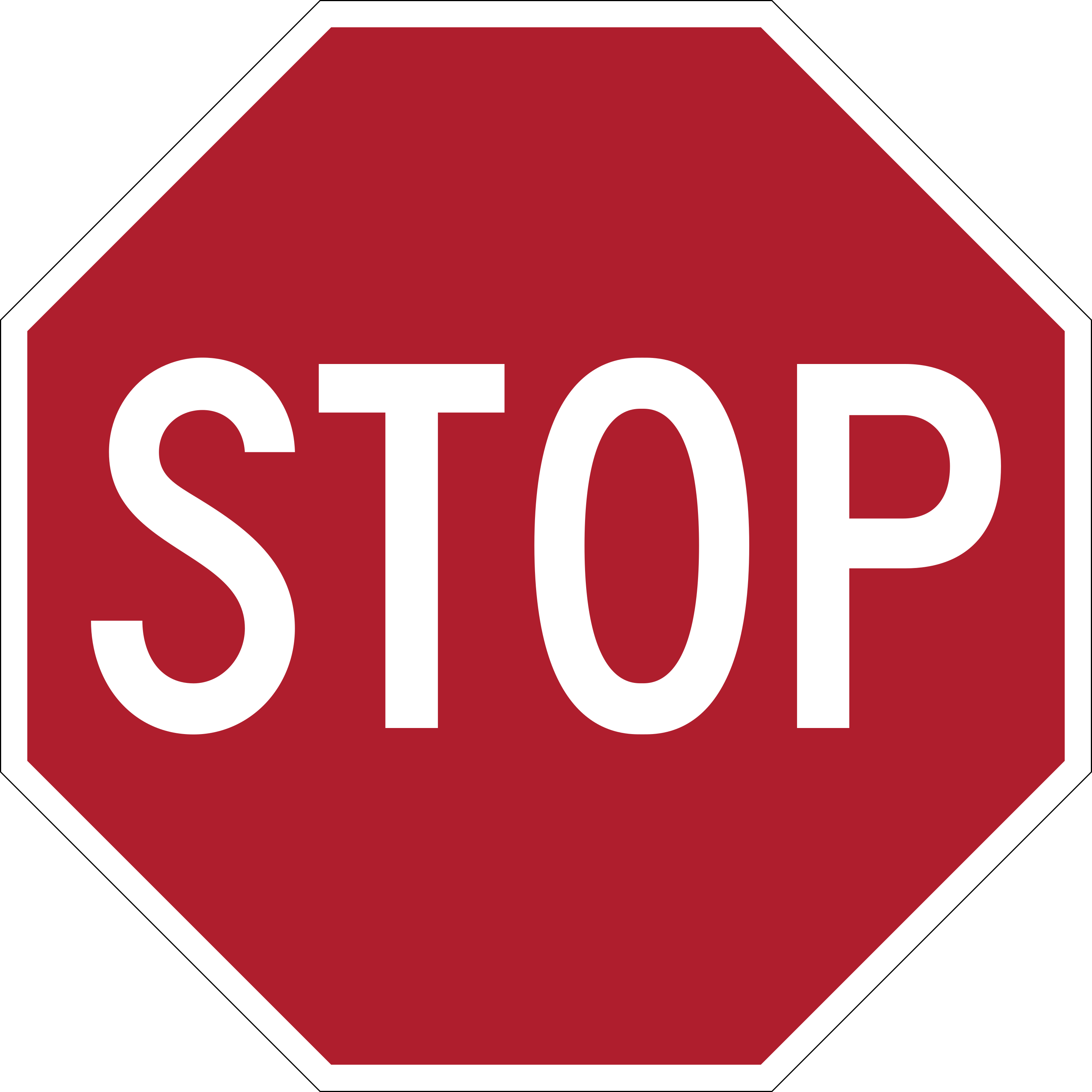
Correct answer: Come to a full stop, then proceed only after yielding to others
The octagon is reserved for stop signs. You must halt completely, look every direction for traffic and pedestrians, and yield before going on.
Source: South Carolina Driver's Manual — Traffic Signs, Stop Sign
6. A motorcycle's turn signal is flashing ahead of you. You should:
Correct answer: Wait to confirm the rider is really turning
Motorcycle signals may not cancel automatically, so wait until you are sure the rider is actually turning before you act.
7. As your speed increases, the distance needed to stop your vehicle:
Correct answer: Increases
The faster you drive, the more time and distance it takes to stop, which is why speed strongly affects stopping distance.
8. For a driver 17 or older, the license is suspended once the point total reaches:
Correct answer: 12 points
A driver 17 or older gets a warning letter at six points, and the license is suspended when the total reaches 12 or more.
Source: South Carolina Driver's Manual — Loss of Driving Privileges
9. A shoulder harness on your safety belt should be worn:
Correct answer: Across your shoulder and chest
The shoulder strap belongs across the shoulder and chest; wearing it under the arm or behind the back can cause serious internal injury in a crash.
10. Before you leave a parallel parking space and pull into traffic, you should:
Correct answer: Signal, check traffic, and yield before pulling out
Signal, use your mirrors, look over your shoulder to check traffic, and yield the right-of-way before moving out.
Source: South Carolina Driver's Manual — Exiting a Parallel Parking Space
11. If your right wheels drop off the edge of the pavement onto an uneven shoulder, you should:
Correct answer: Slow gradually, then ease gently back on
Avoid panic steering; slow down gradually when safe, then steer gently back onto the pavement with only slight wheel movement.
Source: South Carolina Driver's Manual — Uneven Surface Drop-Offs
12. Yellow lines painted down the center of a road separate:
Correct answer: Traffic traveling in opposite directions
Yellow markings divide traffic moving in opposite directions, while white lines separate lanes going the same way.
Source: South Carolina Driver's Manual — Pavement Markings, Yellow Lane Markings
13. A driver under 21 who refuses the test for intoxicants will lose driving privileges for at least:
Correct answer: Six months
Refusing the required breath, blood, or urine test causes an immediate loss of driving privileges for at least six months.
Source: South Carolina Driver's Manual — Alcohol and the Law
14. Two vehicles reach a four-way stop at the same moment. Which driver should yield?
Correct answer: The driver on the left yields to the one on the right
When two drivers arrive together at a four-way stop, the driver on the left yields to the driver on the right.
Source: South Carolina Driver's Manual — Yielding Right-of-Way
15. Before entering an intersection you have stopped at, the recommended visual scan is to:
Correct answer: Look left, then right, then left again
Look left, then right, then left again before moving into an intersection to be sure the path stays clear.
16. Green, brown, or blue signs shaped like squares or rectangles usually serve what purpose?
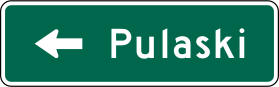
Correct answer: They direct you to towns, routes, and roadside services
Guide signs point you toward cities, intersecting roads, and services like fuel, food, lodging, and hospitals.
Source: South Carolina Driver's Manual — Traffic Signs, Guide Signs
17. When you approach and pass a bicyclist, you should:
Correct answer: Slow down and allow plenty of room
Slow down and give the bicyclist as much space as possible, considering the cyclist's speed as you pass.
Source: South Carolina Driver's Manual — Bicyclists / Passing
18. When driving through a work zone, you should always:
Correct answer: Reduce your speed
Reduce your speed in every work zone, even when no workers are present, because narrow lanes and rough pavement create hazards.
19. The minimum age to obtain a beginner's permit in South Carolina is:
Correct answer: 15 years old
The minimum age is 15; applicants must also pass the eyesight and written exams to receive the permit.
20. When you approach a stopped emergency vehicle with its lights on, the Move-Over law tells you to:
Correct answer: Change lanes away from it and slow down when safe
You must slow down and move into a lane farther from the emergency vehicle when it is safe; if changing lanes is unsafe, reduce speed and pass cautiously.