Connecticut CDL — General Knowledge practice
Connecticut CDL — General Knowledge: Road Signs practice test
Learn the shapes, colors, and meanings of regulatory, warning, and guide signs — from stop and yield to construction and school-zone signs.
Content reviewed against official driver handbooks · August 12, 2026
13 questions · pass with 10 correct. You get instant feedback and an explanation after every answer.
Choose your level
Up to 20 questions on this topic, with feedback after every answer.
Study questions with answers
12 sample Road Signs questions with the correct answer, a short explanation, and the official handbook reference. Read through them, then take the quiz above.
Show all 12 questions with answers
1. What does an X-shaped crossbuck sign at a grade crossing require of a driver?
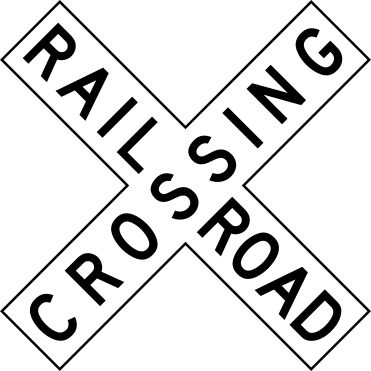
Correct answer: Give the train the right-of-way at the crossing
The crossbuck marks the crossing and tells you to give the right-of-way to any train that is using the tracks.
Source: Connecticut CDL Manual - Section 2: Driving Safely
2. How many separate hazard classes are listed in the hazardous-materials class chart?
Correct answer: Nine
The chart lists nine numbered hazard classes, from explosives through miscellaneous hazardous materials.
Source: Connecticut CDL Manual - Section 2: Driving Safely
3. When a downgrade sign reads 'Maximum Safe Speed,' what should a commercial driver do?
Correct answer: Never travel faster than the number shown
A posted maximum-safe-speed figure is an upper limit you must never go above on that grade.
Source: Connecticut CDL Manual - Section 2: Driving Safely
4. What shape must a hazardous-materials placard be displayed in on a vehicle?
Correct answer: A square turned to sit on one of its points
Placards are square-on-point signs, tilted so they form a diamond, making them easy for responders to recognize from any direction.
Source: Connecticut CDL Manual - Section 2: Driving Safely
5. The four-digit identification number for a hazardous material on a placard or orange panel is preceded by which letters?
Correct answer: NA or UN
Identification numbers used by first responders are shown with the prefix 'NA' or 'UN' in front of the four-digit code.
Source: Connecticut CDL Manual - Section 2: Driving Safely
6. What is the minimum required size of a hazardous-materials placard?
Correct answer: At least 9.84 inches (250 mm) square
Placards must measure at least 9.84 inches (250 mm) on each side and stand upright on a point in a diamond form.
Source: Connecticut CDL Manual - Section 2: Driving Safely
7. On the hazard-class chart, gasoline and acetone fall under which numbered class?
Correct answer: Class 3
Flammable liquids such as gasoline and acetone are grouped as hazard Class 3.
Source: Connecticut CDL Manual - Section 2: Driving Safely
8. The slow-moving-vehicle emblem you may see on farm equipment is what shape and color?
Correct answer: A red-bordered triangle with an orange middle
A slow-moving vehicle is marked by a triangle that is red around its edge with an orange center, warning you to expect very low speeds.
Source: Connecticut CDL Manual - Section 2: Driving Safely
9. What is an escape ramp, which is marked by signs on mountain downgrades?
Correct answer: A soft-surface bed built to stop a runaway vehicle
An escape ramp is a bed of loose, soft material, sometimes on an upgrade, built to bring a runaway truck safely to a stop.
Source: Connecticut CDL Manual - Section 2: Driving Safely
10. How many identical placards must be shown on a vehicle that is required to be placarded?
Correct answer: Four
A placarded load carries four matching placards, one on the front, one on the rear, and one on each side.
Source: Connecticut CDL Manual - Section 2: Driving Safely
11. Battery acid and hydrochloric acid are examples of which hazard class?
Correct answer: Class 8
Corrosive substances like battery acid belong to hazard Class 8.
Source: Connecticut CDL Manual - Section 2: Driving Safely
12. What does the round warning sign posted ahead of a public railroad crossing look like?
Correct answer: Black lettering on a yellow round sign
The advance-warning marker for a grade crossing is a round sign with black symbols on a yellow background, telling you to slow, look and listen.
Source: Connecticut CDL Manual - Section 2: Driving Safely
More CDL — General Knowledge topics
Practice Road Signs in another state
Every Connecticut question is written from the official Connecticut driver handbook and checked against its current edition. DMV Test Free is a free, independent study resource — not affiliated with any DMV or government agency. About DMV Test Free