Práctica CDL — Conocimientos generales de Connecticut
Connecticut CDL — Conocimientos generales: examen de práctica de Señales de tránsito
Aprende las formas, los colores y los significados de las señales reglamentarias, de advertencia y de guía: desde alto y ceda el paso hasta señales de construcción y de zona escolar.
Contenido revisado con los manuales oficiales del conductor · 12 de agosto de 2026
13 preguntas · aprueba con 10 correctas. Recibes retroalimentación instantánea y una explicación después de cada respuesta.
Elige tu nivel
Hasta 20 preguntas de este tema, con retroalimentación después de cada respuesta.
Preguntas de estudio con respuestas
12 preguntas de ejemplo sobre Señales de tránsito con la respuesta correcta, una breve explicación y la referencia del manual oficial. Léelas y luego haz el examen de arriba.
Ver las 12 preguntas con respuestas
1. ¿Qué le exige al conductor una señal en forma de cruz (crossbuck) en un cruce a nivel?
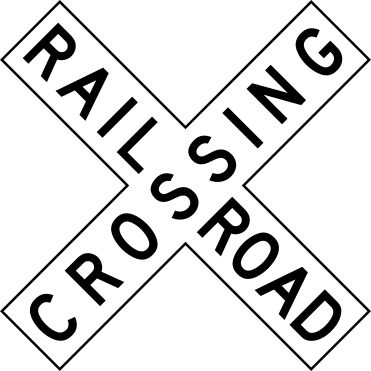
Respuesta correcta: Ceder el paso al tren en el cruce
El crossbuck marca el cruce y le indica que ceda el paso a cualquier tren que esté usando las vías.
Fuente: Manual CDL de Connecticut - Sección 2: Conducir con seguridad
2. El número de identificación de cuatro dígitos de un material peligroso en un cartel o panel anaranjado, ¿va precedido de qué letras?
Respuesta correcta: NA o UN
Los números de identificación que usan los equipos de emergencia se muestran con el prefijo 'NA' o 'UN' delante del código de cuatro dígitos.
Fuente: Manual CDL de Connecticut - Sección 2: Conducir con seguridad
3. Cuando una señal de bajada dice 'Velocidad máxima segura', ¿qué debe hacer un conductor comercial?
Respuesta correcta: Nunca ir más rápido que el número indicado
Una velocidad máxima segura indicada es un límite superior que nunca debe sobrepasar en esa pendiente.
Fuente: Manual CDL de Connecticut - Sección 2: Conducir con seguridad
4. ¿En qué forma debe mostrarse un cartel (placard) de materiales peligrosos en un vehículo?
Respuesta correcta: Un cuadrado girado para apoyarse sobre una de sus puntas
Los carteles son señales cuadradas apoyadas sobre una punta, inclinadas de modo que forman un rombo, lo que facilita que los equipos de emergencia los reconozcan desde cualquier dirección.
Fuente: Manual CDL de Connecticut - Sección 2: Conducir con seguridad
5. ¿Cuántas clases de peligro distintas se enumeran en la tabla de clases de materiales peligrosos?
Respuesta correcta: Nueve
La tabla enumera nueve clases de peligro numeradas, desde explosivos hasta materiales peligrosos misceláneos.
Fuente: Manual CDL de Connecticut - Sección 2: Conducir con seguridad
6. ¿Qué es una rampa de escape, señalizada en las bajadas de montaña?
Respuesta correcta: Un lecho de superficie blanda construido para detener un vehículo sin frenos
Una rampa de escape es un lecho de material suelto y blando, a veces en subida, construido para detener con seguridad a un camión sin frenos.
Fuente: Manual CDL de Connecticut - Sección 2: Conducir con seguridad
7. ¿Cómo es la señal de advertencia redonda que se coloca antes de un cruce de ferrocarril público?
Respuesta correcta: Letras negras sobre una señal redonda amarilla
El marcador de advertencia previa para un cruce a nivel es una señal redonda con símbolos negros sobre fondo amarillo, que le indica reducir la velocidad, mirar y escuchar.
Fuente: Manual CDL de Connecticut - Sección 2: Conducir con seguridad
8. ¿Cuántos carteles idénticos deben mostrarse en un vehículo que está obligado a llevar carteles?
Respuesta correcta: Cuatro
Una carga con carteles lleva cuatro carteles iguales: uno al frente, uno atrás y uno a cada lado.
Fuente: Manual CDL de Connecticut - Sección 2: Conducir con seguridad
9. El emblema de vehículo lento que puede ver en la maquinaria agrícola, ¿de qué forma y color es?
Respuesta correcta: Un triángulo con borde rojo y centro anaranjado
Un vehículo lento se identifica con un triángulo de borde rojo y centro anaranjado, que le advierte que espere velocidades muy bajas.
Fuente: Manual CDL de Connecticut - Sección 2: Conducir con seguridad
10. El ácido de batería y el ácido clorhídrico son ejemplos de ¿qué clase de peligro?
Respuesta correcta: Clase 8
Las sustancias corrosivas como el ácido de batería pertenecen a la Clase de peligro 8.
Fuente: Manual CDL de Connecticut - Sección 2: Conducir con seguridad
11. En la tabla de clases de peligro, la gasolina y la acetona, ¿en qué clase numerada están?
Respuesta correcta: Clase 3
Los líquidos inflamables como la gasolina y la acetona se agrupan en la Clase de peligro 3.
Fuente: Manual CDL de Connecticut - Sección 2: Conducir con seguridad
12. En un camino de dos carriles, la marca en el pavimento que advierte de un cruce de ferrocarril, ¿qué incluye?
Respuesta correcta: Una 'X' con 'RR' y una línea de prohibido rebasar
El cruce se pinta en el pavimento como una gran X, junto con las letras RR y una línea que prohíbe rebasar.
Fuente: Manual CDL de Connecticut - Sección 2: Conducir con seguridad
Más temas de CDL — Conocimientos generales
Practica Señales de tránsito en otro estado
Cada pregunta de Connecticut se escribe a partir del manual oficial del conductor de Connecticut y se verifica con su edición vigente. DMV Test Free es un recurso de estudio gratuito e independiente, sin afiliación con ningún DMV o agencia gubernamental. Acerca de DMV Test Free