Oklahoma CDL — General Knowledge practice
Oklahoma CDL — General Knowledge: Road Signs practice test
Learn the shapes, colors, and meanings of regulatory, warning, and guide signs — from stop and yield to construction and school-zone signs.
Content reviewed against official driver handbooks · August 12, 2026
14 questions · pass with 11 correct. You get instant feedback and an explanation after every answer.
Choose your level
Up to 20 questions on this topic, with feedback after every answer.
Study questions with answers
12 sample Road Signs questions with the correct answer, a short explanation, and the official handbook reference. Read through them, then take the quiz above.
Show all 12 questions with answers
1. What does the X-shaped crossbuck sign at a grade crossing legally require of you?
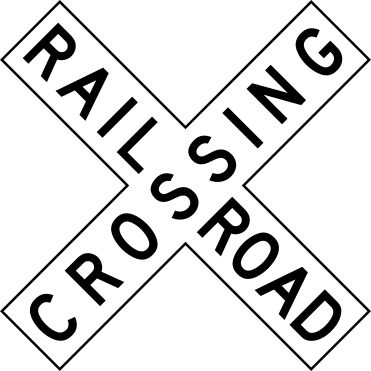
Correct answer: Yield the right-of-way to an approaching train
The crossbuck marks the crossing and requires drivers to yield the right-of-way to any train using the tracks.
Source: Oklahoma CDL Manual — Railroad-Highway Crossings
2. The round, yellow railroad advance-warning sign posted ahead of a crossing tells a driver to do what?

Correct answer: Slow down, watch and listen for a train, and be prepared to stop
This circular black-on-yellow sign warns you to reduce speed, look and listen for a train, and be ready to halt at the tracks if one is coming.
Source: Oklahoma CDL Manual — Railroad-Highway Crossings
3. A small sign mounted just below a crossbuck tells you what?
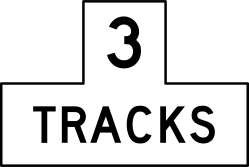
Correct answer: The number of tracks at the crossing
When a crossing has more than one set of rails, a sign under the crossbuck shows how many tracks you must cross.
Source: Oklahoma CDL Manual — Railroad-Highway Crossings
4. Why does a shipper place diamond-shaped labels on packages of hazardous material?
Correct answer: To warn handlers and drivers of the hazard
The labels warn dockworkers and drivers of the risk the cargo poses during handling and transport.
Source: Oklahoma CDL Manual — Hazardous Materials Rules
5. In what shape are hazardous-materials placards displayed on a vehicle?
Correct answer: A diamond standing on one point
Placards are set point-up in a diamond outline so they can be read from every direction around the vehicle.
Source: Oklahoma CDL Manual — Hazardous Materials Rules
6. Explosives such as dynamite and fireworks belong to which hazard class?
Correct answer: Class 1
In the nine-class system, explosives are grouped in Class 1.
Source: Oklahoma CDL Manual — Hazardous Materials Rules
7. A placarded vehicle must carry how many identical placards, and where are they placed?
Correct answer: Four, on the front, rear, and both sides
The rules require at least four matching placards mounted on the front, the rear, and both sides so they are readable from all directions.
Source: Oklahoma CDL Manual — Hazardous Materials Rules
8. What is the minimum size of a hazardous-materials placard?
Correct answer: About 9.84 inches (250 mm) on each side
A placard must measure at least about 9.84 inches (250 mm) on each side; the smaller four-inch diamond is a package hazard label, not a placard.
Source: Oklahoma CDL Manual — Hazardous Materials Rules
9. On a steep downgrade, what does a sign reading 'Maximum Safe Speed' tell you?
Correct answer: Never travel faster than the speed shown
Where such a sign or a posted limit appears, you must never travel faster than the speed shown.
Source: Oklahoma CDL Manual — Controlling Speed & Managing Space
10. Pavement markings showing a large 'X' with the letters 'RR' mean the same as what?
Correct answer: The railroad advance-warning sign
These markings carry the same meaning as the railroad advance-warning sign.
Source: Oklahoma CDL Manual — Railroad-Highway Crossings
11. The four-digit identification number for a hazardous material is preceded by which letters?
Correct answer: 'NA' or 'UN'
Identification numbers used by first responders are shown with an 'NA' or 'UN' prefix.
Source: Oklahoma CDL Manual — Hazardous Materials Rules
12. Battery fluid and hydrochloric acid fall under which hazard class?
Correct answer: Class 8, Corrosives
Corrosives, including acids and battery fluid, are grouped in Class 8.
Source: Oklahoma CDL Manual — Hazardous Materials Rules
More CDL — General Knowledge topics
Practice Road Signs in another state
Every Oklahoma question is written from the official Oklahoma driver handbook and checked against its current edition. DMV Test Free is a free, independent study resource — not affiliated with any DMV or government agency. About DMV Test Free