Free North Carolina DMV Car / Permit Practice Test 2026
The North Carolina Car / Permit knowledge test has ~25 questions, and you need ~20 correct (80%) to pass. Practice free with questions written from the official North Carolina driver handbook — every one has a clear explanation, and you can retake as often as you like with no sign-up.
Content reviewed against official driver handbooks · August 12, 2026
What's on the North Carolina written test
The North Carolina Car / Permit knowledge test has ~25 questions; you need ~20 correct (80%) to pass.
Based on the official North Carolina exam format — always confirm current details with your state DMV.
Practice by topic
Focus on one area at a time — each topic has its own set of North Carolina practice questions.
Learn the shapes, colors, and meanings of regulatory, warning, and guide signs — from stop and yield to construction and school-zone signs.
Speed limits, turning and signaling rules, headlight and seat-belt requirements, and the everyday laws every driver must follow.
How to read traffic signals, lane lines, and pavement markings — including yellow and white lines, arrows, and flashing lights.
Who goes first at intersections, four-way stops, roundabouts, and crosswalks, and how to yield to pedestrians and emergency vehicles.
Following distance, scanning, blind spots, using your lights, and the habits that prevent crashes and keep you in control.
Driving safely around motorcycles, bicycles, large trucks, pedestrians, and school buses — and knowing who has the right of way.
Blood alcohol limits, zero-tolerance and implied-consent laws, and how alcohol and drugs — legal or not — affect your driving.
Legal and illegal parking, colored curbs, distances from hydrants and crossings, and how to park safely on hills.
Choosing a safe speed, keeping a space cushion, adjusting for weather and traffic, and understanding stopping distance.
What to do when things go wrong — brake failure, tire blowouts, skids, and stalling on railroad tracks.
The point system, license suspension, provisional-license rules, insurance requirements, and other licensing basics.
How to pass the first time
- Read the official North Carolina driver handbook at least once before test day.
- Practice by topic to find your weak spots, then fix them.
- Take full-length practice tests until you pass comfortably every time.
- Read every explanation — understanding beats memorizing.
North Carolina Car / Permit test — frequently asked questions
How many questions are on the North Carolina Car / Permit test?
The North Carolina Car / Permit knowledge test has ~25 questions, and you need ~20 correct (80%) to pass. Our practice tests mirror that format.
How many questions can I miss on the North Carolina Car / Permit test?
You can miss up to ~5 of the ~25 questions and still pass — you need ~20 correct, which is 80%.
Can I retake the practice test?
Yes — practice as often as you like, completely free. The questions and answer choices are shuffled each time.
Can I take the North Carolina practice test in Spanish?
Yes. Every question here is available in English and Spanish — switch languages anytime. Many states also offer the real knowledge test in languages other than English; confirm what North Carolina offers with your DMV.
Can I practice on my phone?
Yes. The practice tests work in any mobile or desktop browser — no app or sign-up needed — so you can study anywhere.
Are these the real DMV test questions?
No. Our questions are original, written from the current official North Carolina driver handbook to match the real test's topics and style. We are not affiliated with any DMV or government agency.
What's the best way to study?
Read the North Carolina driver handbook, practice by topic to target weak areas, and finish with full-length tests until you consistently pass.
Other North Carolina practice tests
Take the Car / Permit test in another state
Every North Carolina question is written from the official North Carolina driver handbook and checked against its current edition. DMV Test Free is a free, independent study resource — not affiliated with any DMV or government agency. About DMV Test Free
North Carolina Car / Permit questions with answers
20 sample questions from the North Carolina Car / Permit question bank — each with the correct answer, a short explanation, and the section of the official handbook it comes from.
Show all 20 questions with answers
1. If your vehicle breaks down on a highway, you should:
Correct answer: Move fully onto the shoulder and exit on the passenger side
Move the vehicle completely onto the shoulder, have everyone exit on the passenger side, and stand off the road away from the vehicle.
2. What does North Carolina law say about using a phone to send text messages or email while driving?
Correct answer: It is against the law on public roads
Texting or emailing behind the wheel is unlawful on public streets, highways, and public vehicular areas for all drivers.
3. What is the correct meaning of an orange sign with an arrow reading 'DETOUR'?
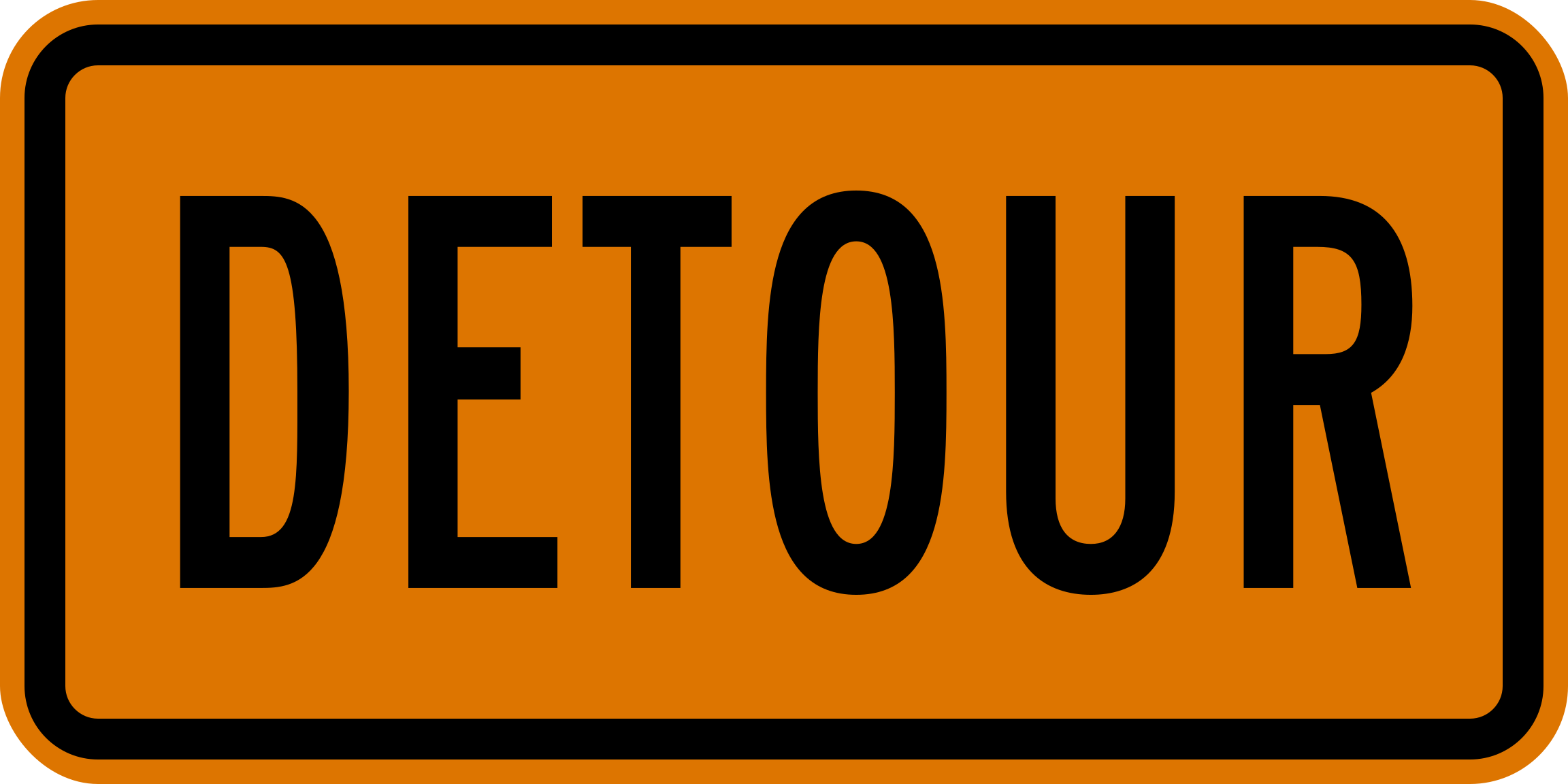
Correct answer: Follow the detour route around a closed or restricted road.
Follow the detour route around a closed or restricted road. (This is the "Detour" sign.)
4. At an uncontrolled intersection, a vehicle that is already in the intersection:
Correct answer: Has the right of way over a vehicle that has not yet entered
A vehicle that has already entered an intersection has the right of way over one that has not yet entered.
Source: North Carolina Driver Handbook — Right-of-Way at Intersections
5. North Carolina requires bicycle helmets for riders and passengers who are:
Correct answer: Under 16 years old
Anyone under 16 who is riding or being carried on a bicycle is required to wear an approved helmet and sit on a saddle seat.
6. Leaving a margin of safety around your vehicle means you:
Correct answer: Keep space so you have room to react and maneuver
Keeping space on all sides gives you room to react and maneuver, and time to make decisions to avoid a crash.
Source: North Carolina Driver Handbook — Keeping a Margin of Safety
7. At a steady red light with no sign forbidding it, a right turn is:
Correct answer: Allowed after a complete stop and yielding
Unless a NO TURN ON RED sign is posted, you may turn right after a complete stop, yielding to pedestrians and cross traffic first.
8. When entering an interstate highway, you should:
Correct answer: Use the acceleration lane to match traffic speed, then merge
Use the acceleration lane to build up to the speed of the other traffic, then merge safely.
Source: North Carolina Driver Handbook — Interstate Highways
9. Which of the following is a legal place to leave a parked car?
Correct answer: In a marked, unrestricted parking space
Parking is prohibited in front of a driveway, on a bridge, and within 15 feet of a fire hydrant; a marked, unrestricted space is a legal spot.
10. A second DWI conviction, when the earlier offense occurred within three years, brings a license revocation of:
Correct answer: Four years
A second DWI conviction carries a mandatory four-year revocation when a prior offense occurred within three years of the current one.
Source: North Carolina Driver Handbook — Driving While Impaired
11. At what blood alcohol concentration is every driver considered impaired under the law?
Correct answer: 0.08 percent
Everyone's driving is impaired at a BAC of 0.08 percent, though many people are affected at lower levels.
Source: North Carolina Driver Handbook — Driving While Impaired
12. When a tire blows out at speed, you should:
Correct answer: Grip the wheel firmly and ease off the gas
Hold the wheel firmly to keep the vehicle straight, ease off the accelerator, and avoid braking until the vehicle has slowed enough to control.
13. For drivers younger than 18, what is the rule on cell phone use while the vehicle is moving?
Correct answer: It is not allowed at all, except to call for emergency help
Drivers under 18 may not use a cell phone or related technology while driving, except to call for help in an emergency.
14. What is the correct meaning of a red octagonal sign?
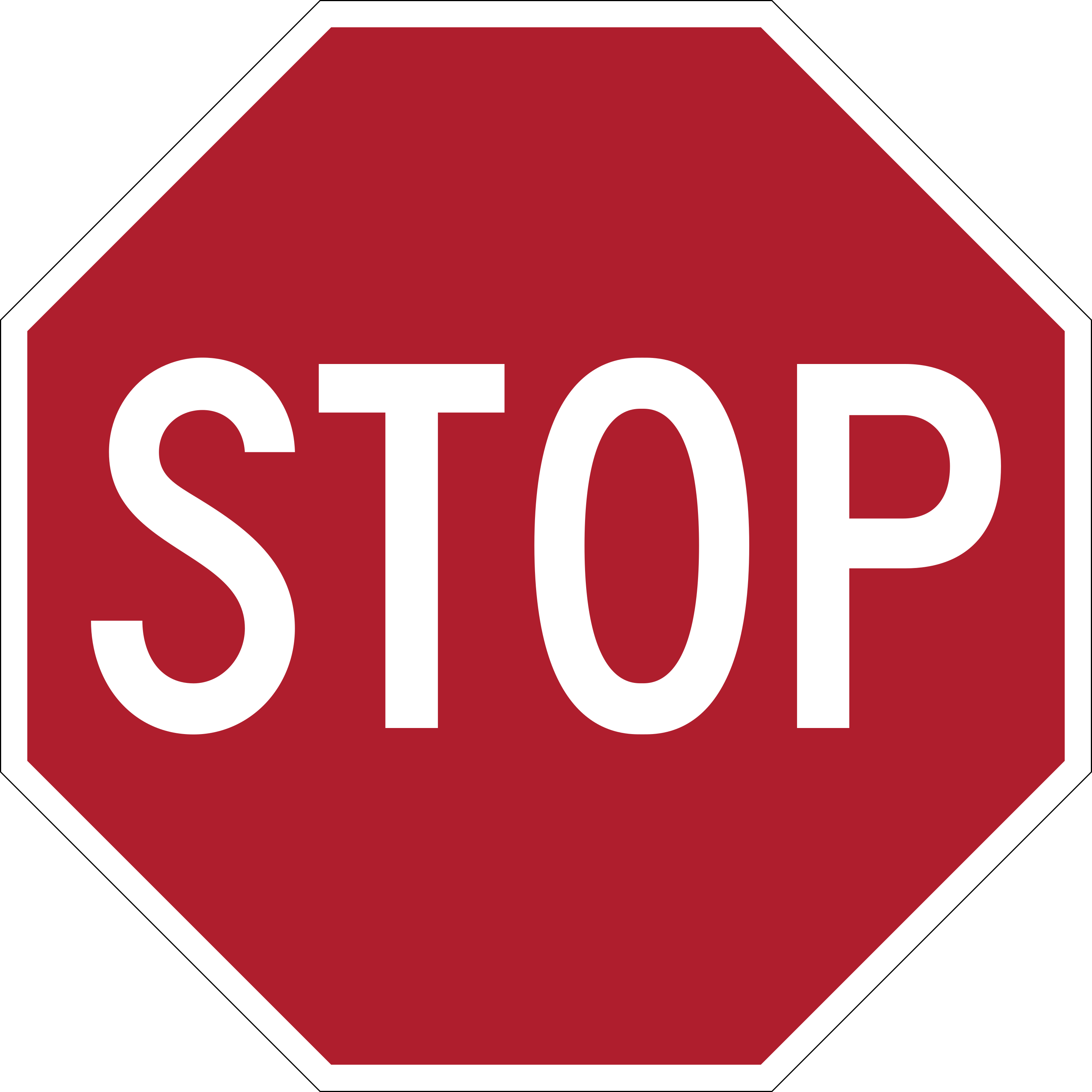
Correct answer: Come to a complete stop at the stop line or crosswalk, then proceed only when it is safe.
Come to a complete stop at the stop line or crosswalk, then proceed only when it is safe. (This is the "Stop" sign.)
15. On an undivided two-lane road, when a school bus stops with its red lights flashing, which vehicles must stop?
Correct answer: Traffic approaching from both directions
On a two-lane road, traffic approaching from both directions must stop for a school bus loading or unloading children.
16. At night, a bicycle must have a front light that is visible from at least:
Correct answer: 300 feet
The law requires a front light visible for at least 300 feet and a rear red light or reflector visible for at least 200 feet.
17. Which of the following is a warning sign that you are too drowsy to keep driving?
Correct answer: You cannot remember the last few miles you drove
Not recalling the last few miles, drifting from your lane, hitting a rumble strip, or repeated yawning are all signs it is time to stop and rest.
18. A steady yellow traffic light is a signal that you should:
Correct answer: Prepare to stop because the light is about to turn red
Yellow means caution and warns that red is coming. Stop if you can do so safely; never speed up to beat the light.
19. To keep a safe gap behind the vehicle in front of you, you should follow:
Correct answer: The two-second rule
The two-second rule is the recommended way to keep enough space to react if the vehicle ahead stops suddenly.
Source: North Carolina Driver Handbook — The Two-Second Rule
20. You may not park within how many feet of a fire hydrant?
Correct answer: 15 feet
You may not leave a vehicle parked closer than 15 feet to a fire hydrant or a fire-station entrance.